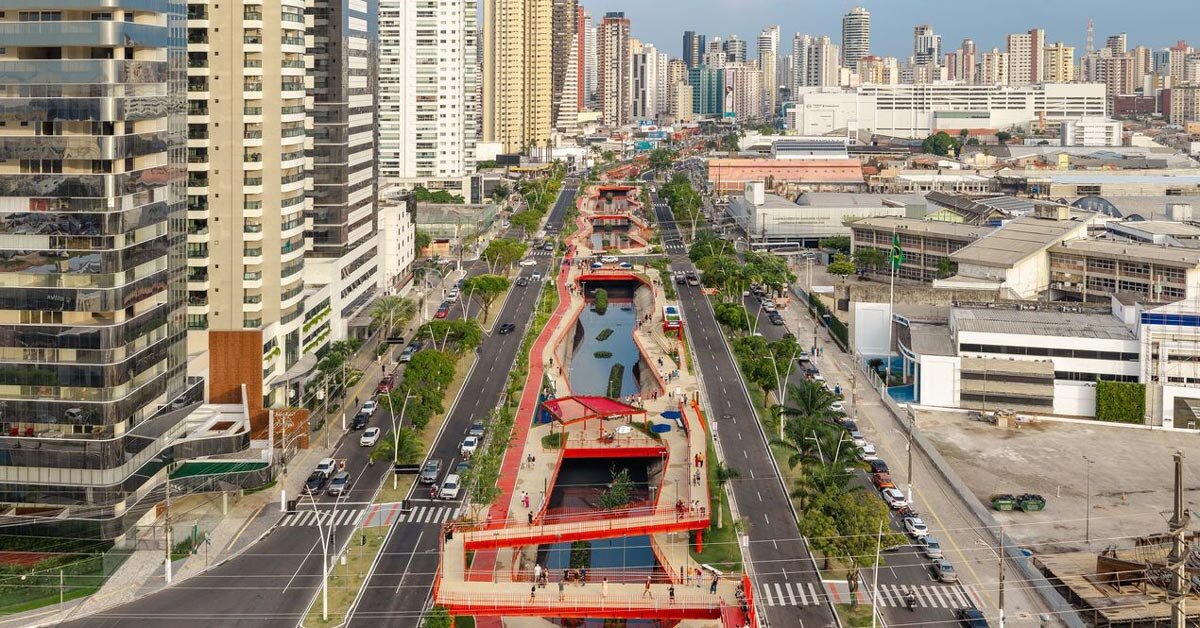
"Designed as one of the key urban legacies for COP30, the project transforms the former canal into a continuous linear park structured around green infrastructure and water-sensitive urban design principles. The historic watercourse becomes the organizing element of the project, shaping a sequence of public spaces for leisure, sports, and everyday use. The design integrates nature-based solutions to improve water quality, reduce diffuse pollution, and support microdrainage, while resilient hydraulic systems address flood mitigation and public safety."
"The intervention addresses the historical disconnection between the city and its waterways by reintroducing water as a central element of public space and urban infrastructure. Belém's urban development progressively buried and fragmented its rivers and igarapés, prioritizing road infrastructure and reducing the presence of water in everyday life. The canal corridor was previously characterized by limited vegetation, low soil permeability, and a lack of public amenities, resulting in an underused and environmentally compromised urban space."
Doca Linear Park converts the former Igarapé das Almas, a 1.2-kilometer canal along Visconde de Sousa Franco Avenue, into a continuous public linear park. The project reconnects the city to its waterways by reintroducing water as a focal element of public space and urban infrastructure. The design restores ecological and spatial continuity using green infrastructure and water-sensitive urban design, creating sequential public spaces for leisure, sports, and everyday use. Nature-based solutions enhance water quality, reduce diffuse pollution, and support microdrainage. Increased soil permeability and native vegetation promote passive cooling, biodiversity, improved drainage, and local microclimate regulation. Resilient hydraulic systems mitigate flooding and improve public safety as part of COP30 urban legacies.
Read at designboom | architecture & design magazine
Unable to calculate read time
Collection
[
|
...
]