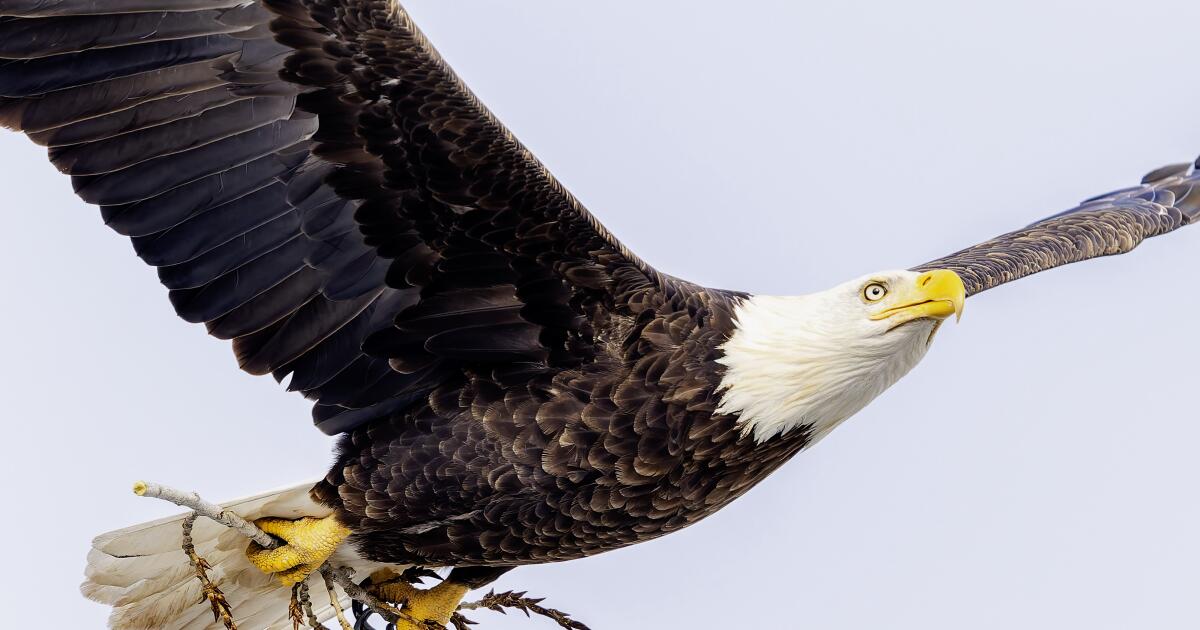
"As scores of students swarmed out of their Milpitas elementary school on a recent afternoon, a lone bald eagle perched high above them in a redwood tree - only occasionally looking down on the after-school ruckus, training his eyes on the grassy hills along the western horizon. The week before, his mate was electrocuted on nearby power lines operated by PG&E."
"What exactly happened to send Hope the eagle off the pair's nest in the dark of night and into the live wires on the night of Nov. 3 is not known (although there's some scandalous speculation it involved a mysterious, "interloper" female). According to a spokesperson from PG&E, an outage occurred in the area at around 9 p.m. Line workers later discovered it was caused by the adult eagle."
"According to a 2014 analysis of bird deaths across the U.S., electrocution on power lines is a significant cause of bird mortality. Every year, as many as 11.6 million birds are fried on the wires that juice our televisions, HVAC systems and blow driers, the authors estimated. The birds die when two body parts - a wing, foot or beak - come in contact with two wires, or when they touch a wire and ground source, sending a fatal current of electricity through the animal's body."
A pair of bald eagles nested near Curtner Elementary School; one adult perched above students while its mate was electrocuted on nearby PG&E power lines. The adult, named Hope, left the nest at night and contacted live wires on Nov. 3, triggering a local outage around 9 p.m. Electrocution is a widespread threat for birds, with a 2014 analysis estimating up to 11.6 million annual deaths on power lines. Large raptors face higher risk because wingspans of 5.5 to 8 feet increase the chance of contacting multiple conductors. A U.S. Fish and Wildlife Service forensics review of 417 electrocuted raptors found nearly 80 percent were bald or golden eagles between 2000 and 2015.
Read at Los Angeles Times
Unable to calculate read time
Collection
[
|
...
]