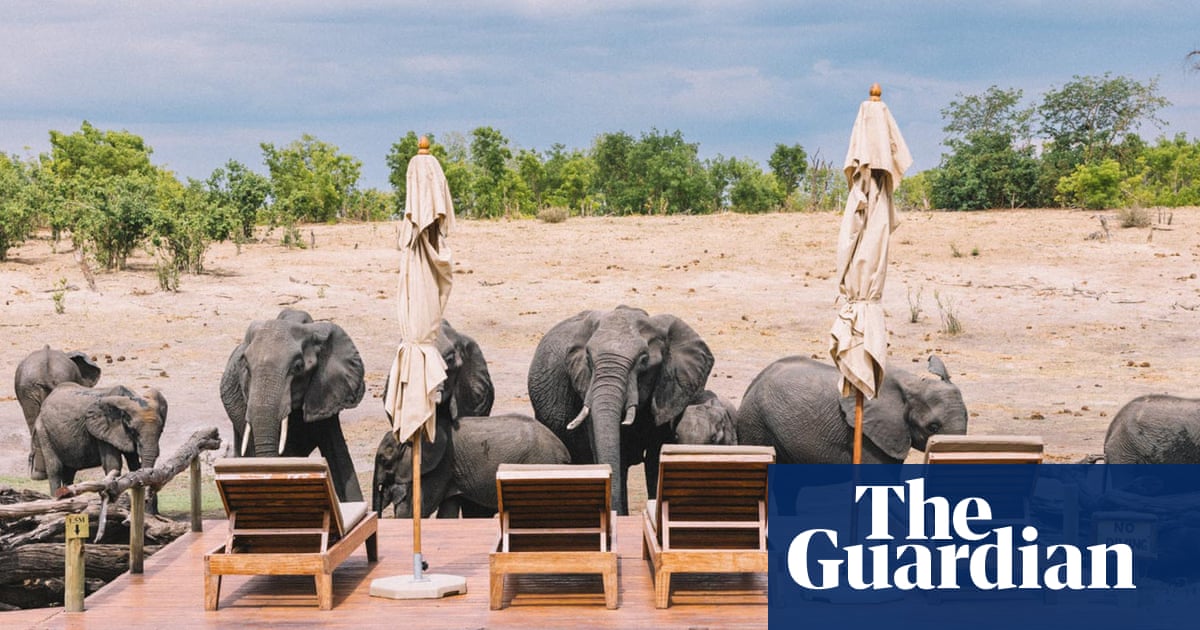
A 20-year-old bull elephant is the last resident of Badingilo National Park and wears a GPS collar that pings hourly. The elephant sometimes travels with giraffes. Mid-20th-century estimates suggested roughly 133,500 elephants in what is now South Sudan; current known numbers are about 5% of that. In contrast, parts of the Kavango Zambezi (Kaza) transfrontier conservation area face elephant overabundance due to effective protection and enforcement. Overabundance in eastern Kaza increases human-wildlife conflict as people and elephants compete for shrinking, less resource-rich land, prompting debate over culling.
"It is late on a January afternoon in the middle of South Sudan's dry season, and the landscape, pricked with stubby acacias, is hazy with smoke from people burning the grasslands to encourage new growth. Even from the perspective of a single-engine ultralight aircraft, we are warned it will be hard to spot the last elephant in Badingilo national park, a protected area covering nearly 9,000 sq km (3,475 sq miles)."
"Technology helps the 20-year-old bull elephant wears a GPS collar that pings coordinates every hour. The animal's behaviour patterns also help; Badingilo's last elephant is so lonely that it moves with a herd of giraffes. Fifty years ago, life for elephants in this part of Africa was very different. In the early 1970s, an English ecologist called Dr Murray Watson crisscrossed the skies of Sudan in a bush plane to measure wildlife populations."
"While Watson's methodology wasn't as reliable as modern counts, he estimated there were about 133,500 elephants in what is now South Sudan. Today, the country's known population of elephants is down to about 5% of what it was 50 years ago, says Mike Fay, a US conservationist who has spent 45 years documenting and securing wildlife populations in the Sahel and central Africa."
#elephant-population-decline #badingilo-national-park #kavango-zambezi-kaza #human-wildlife-conflict
Read at www.theguardian.com
Unable to calculate read time
Collection
[
|
...
]