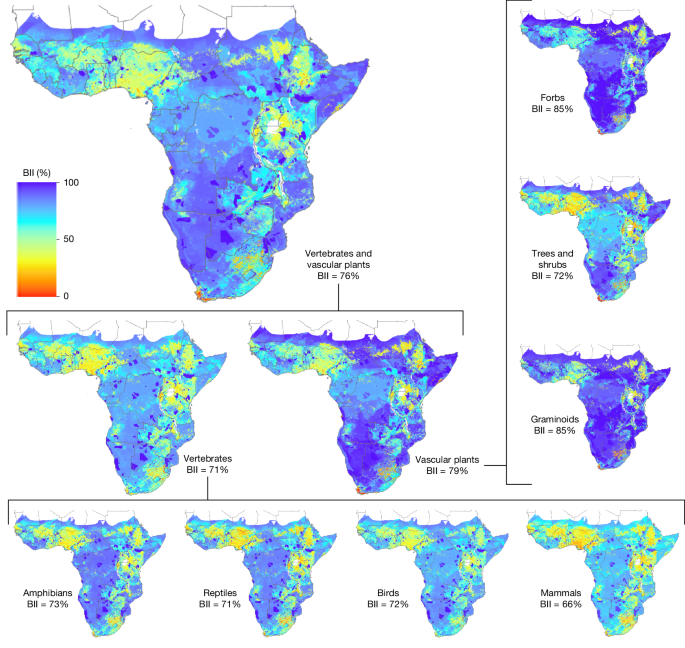
"One major limitation to achieving conservation goals is the lack of information on the impacts of diverse human activities on biodiversity and resulting ecosystem functions and services2,3. To be useful in national and international decision-making, such information needs to be comparable across spatial and temporal scales and capture changes in biodiversity relevant to sustaining societies and economies2,3. Ecosystem condition or integrity represents the degree to which the composition, structure and function of an ecosystem resembles that of its reference state7."
"The biodiversity intactness index4 (BII) is an indicator of ecosystem condition that holds promise for mainstreaming biodiversity into policy and planning7. The BII assesses human impacts on the abundance of a wide range of species that contribute diverse functions and capture the multidimensional nature of biodiversity in a way that can be compared across multiple scales and time periods4,8. However, the limited availability of appropriate data to quantify indicators such as the BII is a major constraint to decision-making, especially in the Global South1,9."
"Available assessments of ecosystem condition are criticized for being top-down; that is, based on global, decontextualized pressure-impact relationships that extrapolate across data-poor regions and taxa. These assessments can have lasting consequences for planning and prioritization10. For example, global assessments of ecosystem condition typically do not differentiate between planted pastureland and untransformed rangeland-a key distinction in the context of sub-Saharan Africa"
Biodiversity is an integral part of sustainable development, yet biodiversity is being lost rapidly and biodiversity management is failing to be embedded in policy and planning. Comparable information on human impacts across spatial and temporal scales is needed to support national and international decision-making and to capture changes relevant to societies and economies. Ecosystem condition or integrity measures how closely composition, structure and function resemble a reference state. The Biodiversity Intactness Index assesses human impacts on species abundance across taxa and scales and can mainstream biodiversity into policy. Limited, context-specific data—especially in the Global South—and top-down, decontextualized assessments constrain accurate measurement and can misinform planning. Global assessments often fail to distinguish between planted pastureland and untransformed rangeland, which matters in regions such as sub-Saharan Africa.
Read at Nature
Unable to calculate read time
Collection
[
|
...
]