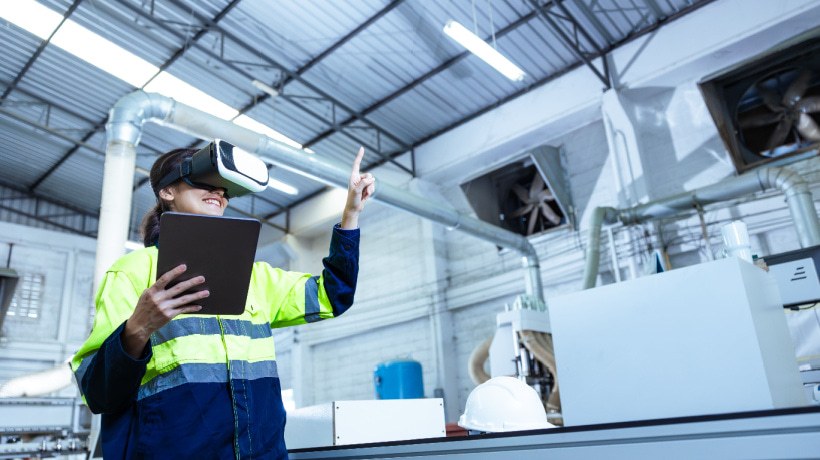
"In today's rapidly evolving industrial landscape, workforce training has reached a pivotal crossroads. Traditional classroom methods-long the backbone of organizational learning-are struggling to keep pace with the demands of advanced manufacturing and logistics industries. These sectors require highly practical, nuanced skills that the conventional lecture-and-handout model simply cannot deliver with precision or depth. As digital transformation accelerates, it's time for organizations to rethink how they prepare their workforce. Immersive technologies-such as Virtual Reality (VR), Augmented Reality (AR), and Mixed Reality (MR)-are emerging as powerful training solutions to bridge the gap between knowledge and workforce performance."
"Traditional training largely relies on passive learning-slideshows, lectures, and printed manuals. These formats are limited in their ability to engage multiple senses or simulate real work environments. Even role-plays and physical equipment labs can't fully recreate the complexity and unpredictability of real operational settings."
Traditional classroom methods rely on passive learning—lectures, slides, and manuals—and fail to build execution competence for complex manufacturing and logistics tasks. Physical hands-on training often cannot replicate real operational variability and exposes trainees to hazards while driving high costs and equipment downtime. Immersive technologies such as VR, AR, and MR enable realistic, repeatable simulations of equipment operation and emergency scenarios without risk. These technologies support multi-sensory practice, objective performance measurement, remote collaboration, and scalable content updates. As a result, immersive training can accelerate proficiency, increase retention, reduce training costs, and improve on-the-job safety and operational performance.
Read at eLearning Industry
Unable to calculate read time
Collection
[
|
...
]