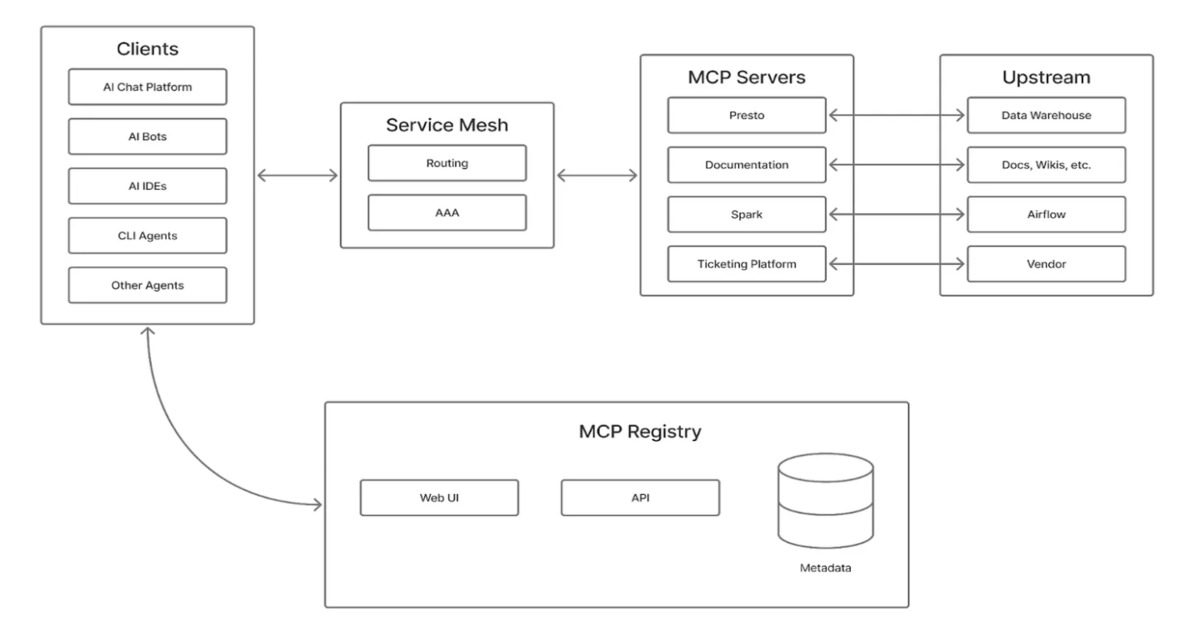
"Pinterest engineers emphasize that by explicitly choosing an architecture of internal cloud-hosted, multiple domain-specific MCP servers connected via a central registry, they have built a flexible and secure substrate for AI agents integrated directly into employees' daily workflows."
"At the core of the implementation is a fleet of cloud-hosted MCP servers, each dedicated to a specific domain such as Presto, Spark, or Airflow, rather than a single monolithic service. This domain-specific approach limits context bloat, isolates tools, and allows fine-grained access control."
"A central MCP registry acts as the source of truth for approved servers and their connectivity metadata. Both a human-friendly UI and an API allow discovery, validation, and integration into internal AI clients and IDEs."
"Pinterest measures ecosystem impact through a single north-star metric: time saved. Tool owners estimate minutes saved per invocation based on lightweight user feedback and comparison to manual workflows."
Pinterest has implemented an internal Model Context Protocol (MCP) ecosystem to automate engineering tasks and integrate diverse tools. This architecture features multiple domain-specific MCP servers connected via a central registry, enhancing flexibility and security. The system allows AI agents to access structured data and perform tasks efficiently. A unified deployment pipeline manages infrastructure and service lifecycles, while a central registry ensures governance and validation of tool access. The impact of the ecosystem is measured by time saved in workflows, with ongoing assessments of efficiency improvements.
Read at InfoQ
Unable to calculate read time
Collection
[
|
...
]