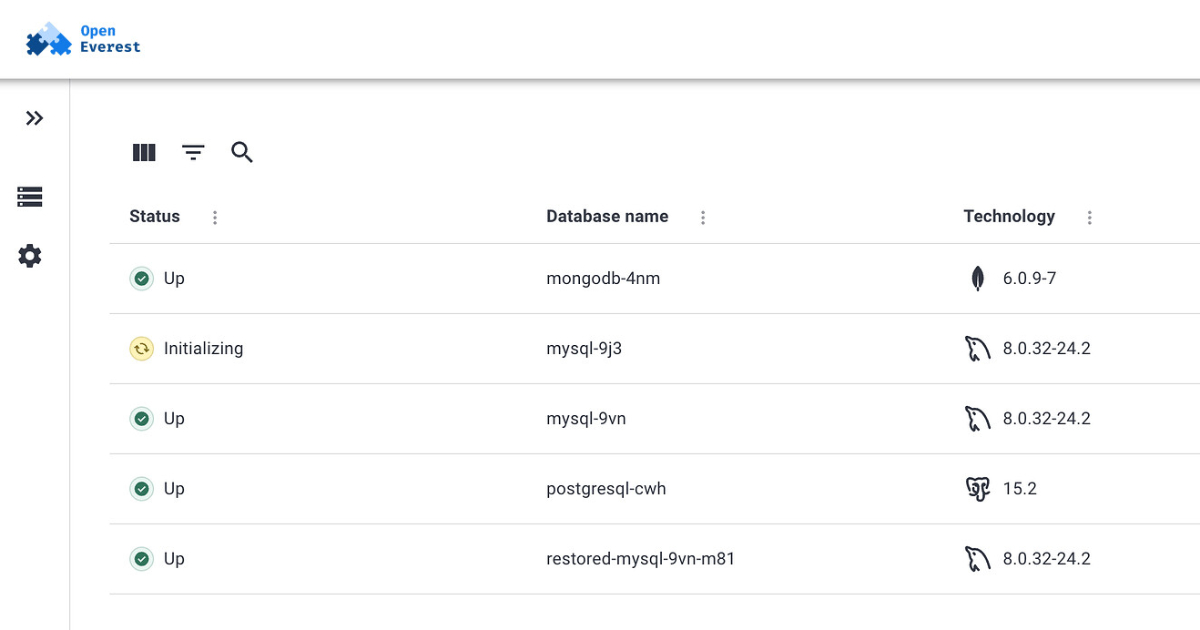
"Percona recently announced OpenEverest, an open-source platform for automated database provisioning and management that supports multiple database technologies. Launched initially as Percona Everest, OpenEverest can be hosted on any Kubernetes infrastructure, in the cloud, or on-premises. The main goal of the project is to avoid vendor lock-in while still providing an automated private DBaaS. Built on top of Kubernetes operators, it aims to avoid complex deployments that depend on a single cloud provider's technology."
"The project simplifies operational tasks such as software updates, monitoring, storage scaling, and external access configuration through its web UI and REST API. The DatabaseCluster, DatabaseClusterBackup, and DatabaseClusterRestore custom resource definitions define how OpenEverest declaratively provisions database clusters and manages their backups and restores in Kubernetes, enabling these operations to be handled as native, versioned Kubernetes objects and hiding most of the differences specific to the database operator."
"Right now, we're focused on database management, but the real vision is bigger than that. We're creating a modular foundation where you can seamlessly plug in additional data engines, connect with your entire operational stack, and tackle a broader range of data infrastructure challenges."
OpenEverest is an open-source platform for automated database provisioning and management that supports multiple database technologies and runs on any Kubernetes infrastructure, cloud, or on-premises. The project aims to prevent vendor lock-in while offering an automated private DBaaS and is built on Kubernetes operators to avoid provider-specific complexity. OpenEverest is modular and plugin-driven, supporting features like GKE Autopilot and pod scheduling policies. A web UI and REST API simplify software updates, monitoring, storage scaling, and external access. Declarative CRDs manage clusters, backups, and restores as versioned Kubernetes objects. Responses to the beta were mixed, sparking debate about running databases on Kubernetes.
Read at InfoQ
Unable to calculate read time
Collection
[
|
...
]