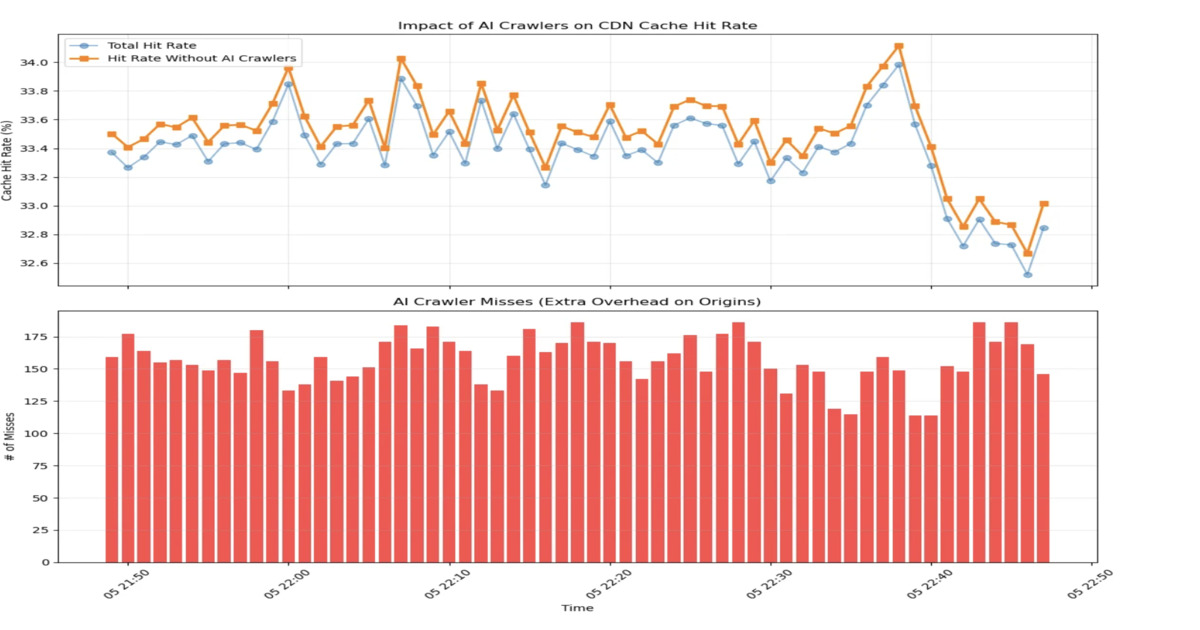
AI-driven crawler traffic has surpassed 10 billion requests weekly, with automated sources constituting about a third of Cloudflare's traffic. AI crawlers, responsible for 80 percent of bot requests, exhibit distinct patterns from human users, such as high unique URL ratios and ineffective cache reuse. This behavior leads to increased cache miss rates and reduced effectiveness of traditional caching strategies. Cloudflare's modeling indicates that AI agents create high levels of unique content access, displacing frequently requested human content and increasing origin server load.
"AI crawler behavior diverges from human browsing in several ways. Many AI crawlers maintain a high unique URL ratio, access diverse content types, and issue requests that do not effectively reuse cached content."
"AI traffic increases cache miss rates for CDNs, reducing the effectiveness of strategies such as least recently used cache eviction, cache speculation, and prefetching."
"The 70-100 percent unique access ratio in RAG loops explains the cache churn I experienced during recent fine-tuning. LRU failing under AI load makes German hosting unpredictable."
Read at InfoQ
Unable to calculate read time
Collection
[
|
...
]