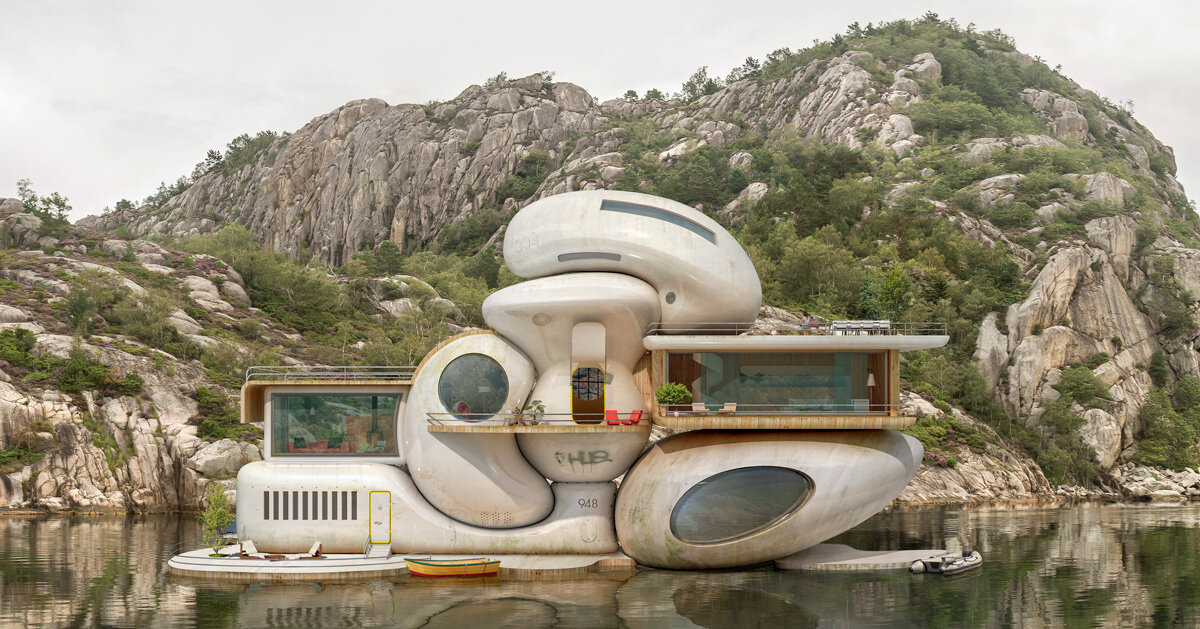
Dionisio González, a Spanish visual artist, develops 'Wittgenstein's Cabin,' a series of conceptual dwellings positioned on Norwegian fjords that blur the boundaries between philosophical retreat and experimental living spaces. Drawing inspiration from Ludwig Wittgenstein's actual remote cabin built in 1914 on Lake Eidsvatnet in Skjolden, González extends this historical model of solitude into contemporary architectural speculation. Using photography, digital manipulation, and architectural fiction, he creates amphibious prototypes that engage with water and landscape. The project considers how Wittgenstein's philosophical work, conducted partly on boats in the Sognefjord, might inform architecture designed for fluid, unstable environments shaped by present-day conditions and natural forces.
"There is something revealing and emphatic in Wittgenstein's Norwegian cabin, and that is the confrontation, the frontality with the fjord, with the water lodged behind the action of the glaciers. Wittgenstein worked on his studies of logic on a boat his friend David Pinsent sailed in the Sognefjord. This fact, this 'event' of the research, the learning and memorizing on a small aquatic means of transport, which serves as a writing desk, led me to consider the relationship of architecture with water."
"How would Wittgenstein frame that organic building, that architectonic construction in a liquid medium with the present media? What would contemporary cabins be like in diffracting settings of propagating waves, such as the Norwegian fjords? The resulting amphibious dwellings operate as prototypes for inhabitation and reflection, translating a historical model of solitude into a speculative architectural language shaped by present-day conditions."
#speculative-architecture #philosophical-refuge #amphibious-design #norwegian-fjords #contemporary-cabins
Read at designboom | architecture & design magazine
Unable to calculate read time
Collection
[
|
...
]