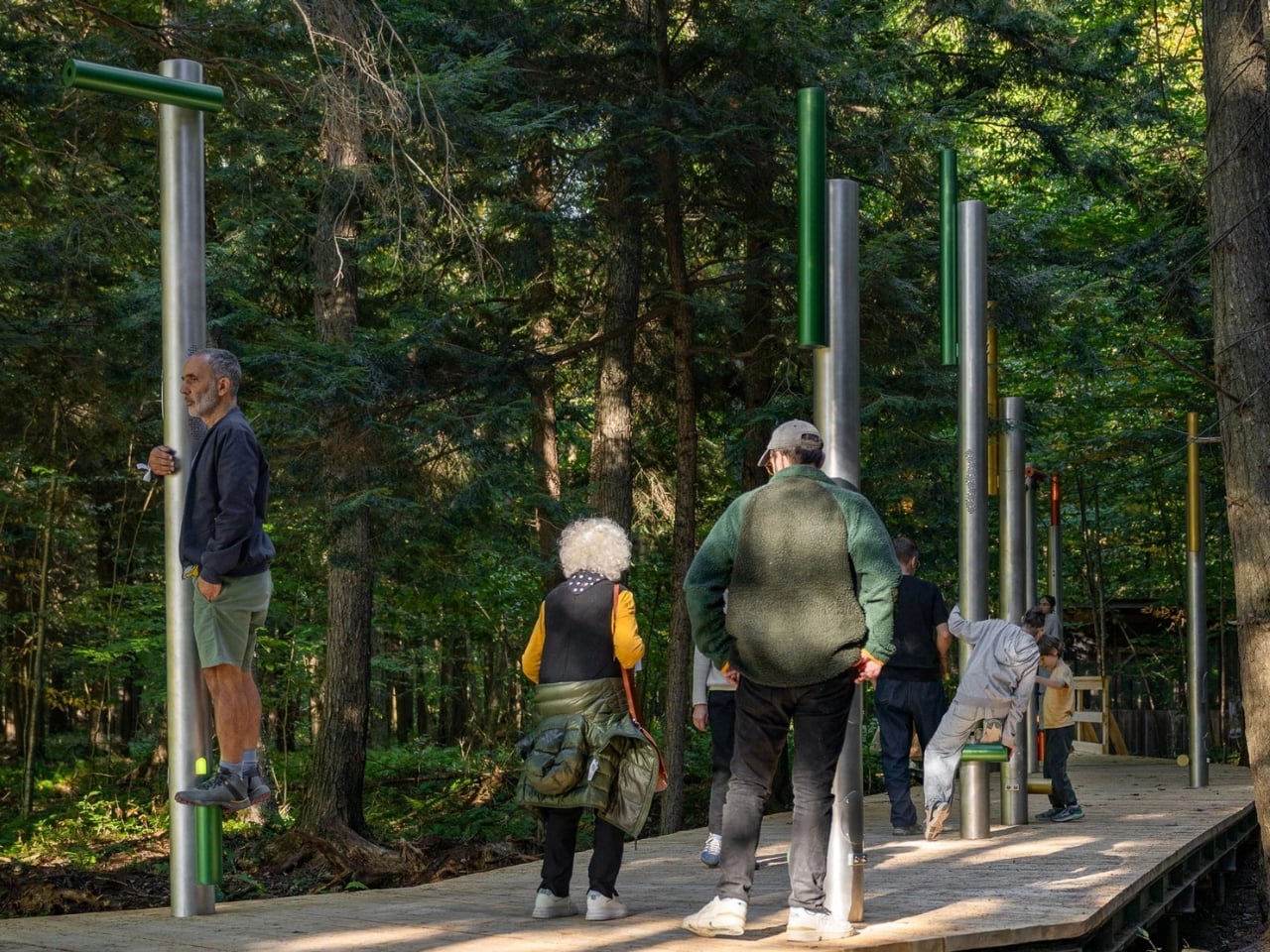
"Picture yourself standing on a small platform in the middle of a Quebec forest, balancing on what feels like an oversized bird perch. The moment your weight settles, something magical happens. A bird call rings out, blending seamlessly into an ethereal soundtrack that seems to rise from the forest itself. Welcome to Human Perches, the latest installation from Montreal design studio Daily tous les jours that's making us rethink how we experience nature."
"Located at Chouette à voir!, a bird of prey sanctuary in St-Jude, Quebec, this permanent installation transforms a 55-meter elevated boardwalk into an interactive musical journey through the seasons. Ten aluminum perching stations punctuate the path, each one waiting for a human visitor to activate its hidden soundscape. The design is brilliantly simple: step onto a green perch, and you become part of the forest's symphony."
"What makes this project so captivating is how it flips our usual relationship with wildlife. We're used to being the noisy intruders, the reason birds fall silent when we approach. Here, we become the activators of sound. When humans aren't present, the artwork stays quiet, mirroring the behavior of the sanctuary's winged residents. It's a poetic reversal that makes you acutely aware of your presence in the ecosystem."
Human Perches transforms a 55-meter elevated boardwalk at Chouette à voir! in St-Jude, Quebec into an interactive series of ten aluminum perching stations that trigger seasonal soundscapes when occupied. Stepping onto a green perch activates hidden audio layers combining recorded local bird calls and abstract compositions by Keiko Devaux. Each perch represents a season—winter, spring, summer, autumn—and the sounds evolve as visitors move, alternating between identifiable bird voices and processed textures or rhythms. The installation remains silent without human presence, mirroring sanctuary behavior and reversing the typical human role as noisy intruder, fostering awareness of human presence within the ecosystem.
Read at Yanko Design - Modern Industrial Design News
Unable to calculate read time
Collection
[
|
...
]