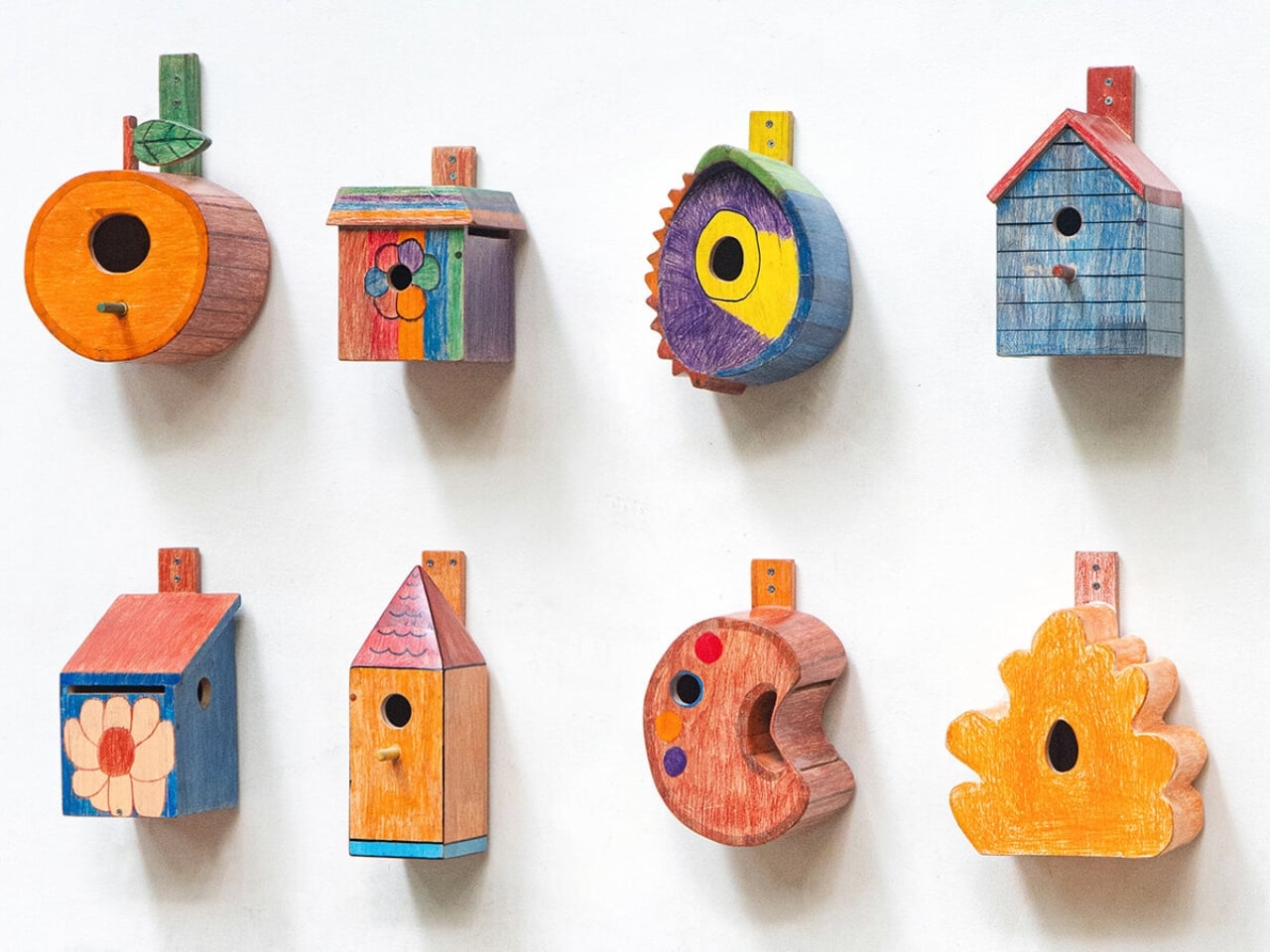
"Most of us have a pretty fixed idea of what a birdhouse looks like. A small wooden box, a round hole, maybe a little perch. It's one of those objects so familiar it barely registers anymore. Designer Taekhan Yun decided to blow that idea up entirely, and he handed the job over to the last people anyone in the design industry would think to consult: ninety children in Siem Reap, Cambodia."
"Yun, a Korean designer currently based in Cambodia, started the process by introducing the children to local bird species and basic birdhouse typologies. Not to teach them the "right" answer, but to give them just enough context before letting them loose with pencils and paper. The drawings that came out of that session were, predictably, wonderfully unruly. Rooftops that curve like waves, doors shaped more like portals, proportions that make zero structural sense and all the visual sense in the world."
"What Yun did next is the part that elevates this from a cute community project to something genuinely worth talking about. He didn't correct the drawings. He translated them. There's a massive difference between those two things, and most professional designers, trained to optimize and problem-solve, would have instinctively done the former. Yun chose the harder path, which was to honor the original intention of each design while figuring out how to make it stand upright, hold together, and actually function as a home for a bird."
"The children then made clay prototypes of their own designs, turning two-dimensional sketches into three-dimensional objects with their own hands. Eight of those designs were ultimately selected and built into full-scale birdhouses, with the children participating in the finishing process alongside Yun. The completed birdhouses now live at the school, sitting in the kind"
A familiar birdhouse form was reimagined through a community design process involving ninety children in Siem Reap, Cambodia. A Korean designer introduced children to local bird species and basic birdhouse typologies to provide context rather than a single correct solution. Children produced drawings with unconventional shapes, including wave-like rooftops, portal-like doors, and proportions that were visually expressive even when structurally impractical. Instead of correcting the drawings, the designer translated them into buildable designs by preserving each child’s intent while solving for stability and functionality. Children then created clay prototypes, and eight designs were selected, built into full-scale birdhouses, and finished with the designer’s guidance. The finished birdhouses were installed at the school.
Read at Yanko Design - Modern Industrial Design News
Unable to calculate read time
Collection
[
|
...
]