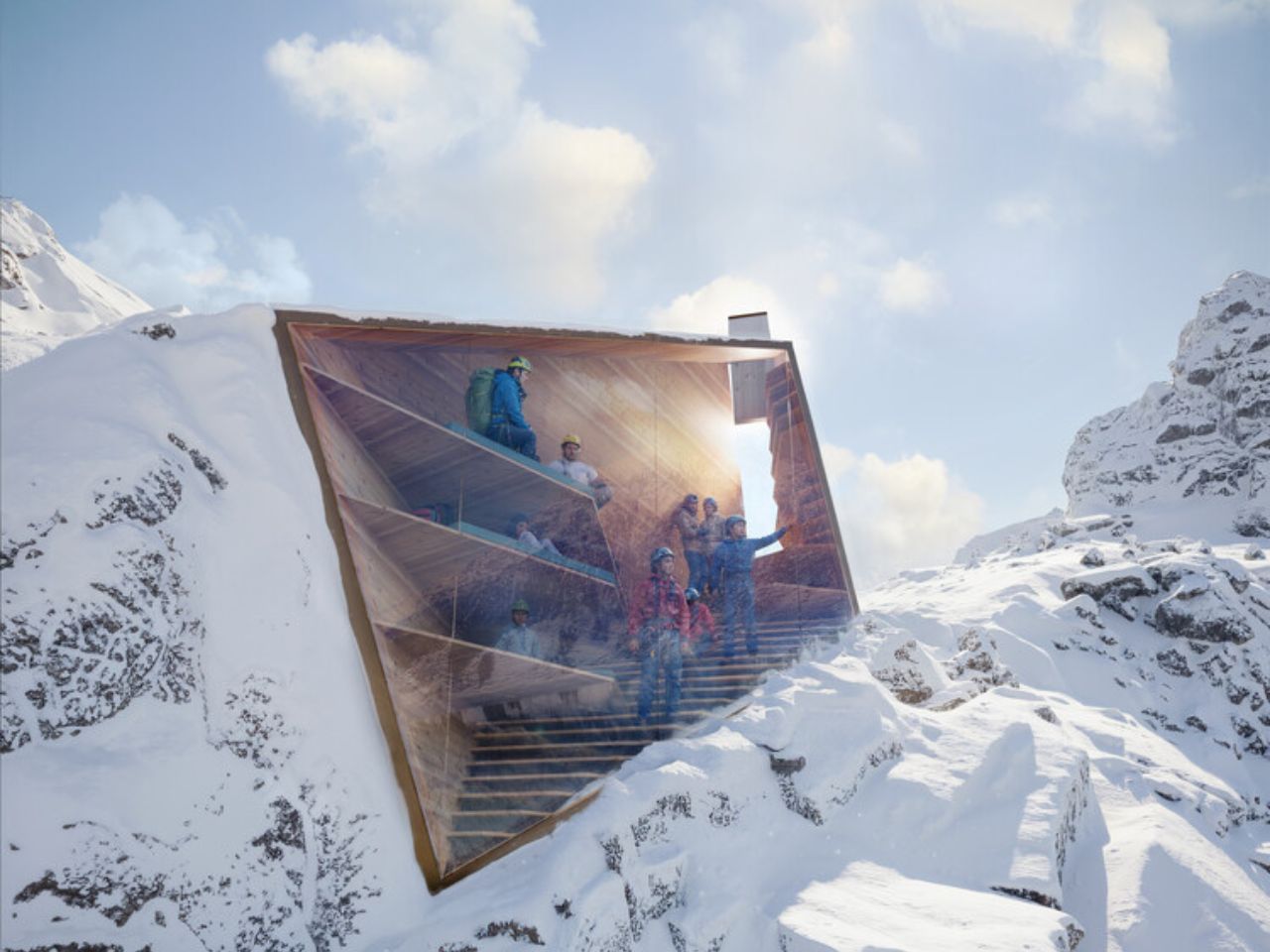
"CRA-Carlo Ratti Associati, in collaboration with Salone del Mobile.Milano, has revealed a striking new architectural experiment for the 2026 Milano Cortina Winter Olympics, a digitally fabricated, self-sufficient wooden bivouac that blurs the boundaries between natural terrain and human ingenuity. What begins as a temporary urban pavilion in Milan will later embark on a second life high above the clouds, airlifted by helicopter to the Italian Alps, where it will stand as a permanent mountain refuge for adventurers and climbers."
"The pavilion's design is guided by the philosophy of harmonizing with the landscape rather than dominating it. The process started with a 3D scan of Alpine rock formations, capturing their raw geometry to inform the pavilion's organic structure. Every angle, curve, and edge of the shelter echoes the crystalline formations of the surrounding peaks. The result is a sculptural wooden structure that appears to have grown from the rock itself, modern technology molded by nature's blueprint."
"Built primarily from cross-laminated timber (CLT), enhanced with aerogel insulation and metal reinforcements, the pavilion merges craftsmanship with digital precision. It integrates a 5 kW photovoltaic system for renewable power generation and an energy storage system that enables off-grid operation. Complementing its energy independence, an air condensation mechanism extracts humidity from the atmosphere, generating fresh drinking water each day. Together, these features make the structure entirely self-reliant, capable of supporting life in remote alpine conditions."
CRA-Carlo Ratti Associati and Salone del Mobile.Milano designed a digitally fabricated wooden pavilion that serves as a temporary urban installation and later a permanent mountain refuge. The structure will be airlifted by helicopter to the Italian Alps to function as a bivouac for climbers and adventurers. The form derives from 3D scans of Alpine rock, reproducing angles, curves and crystalline edges to create an organic sculptural shell. Built mainly from cross-laminated timber with aerogel insulation and metal reinforcement, the shelter combines craftsmanship with digital precision. A 5 kW photovoltaic array and energy storage provide off-grid power. An air-condensation system produces daily drinking water, enabling full self-reliance.
#digital-fabrication #cross-laminated-timber-clt #off-grid-renewable-systems #alpine-bivouac #atmospheric-water-generation
Read at Yanko Design - Modern Industrial Design News
Unable to calculate read time
Collection
[
|
...
]