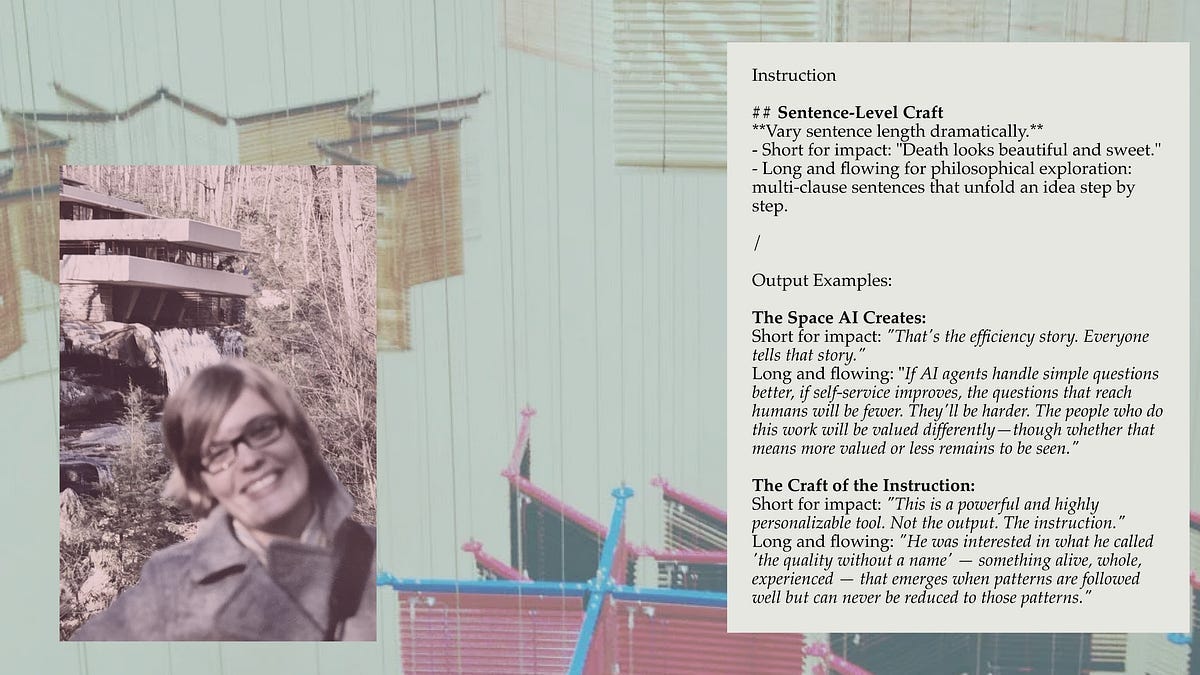
Writing can be produced with Claude using crafted instructions rather than relying on the model alone. Those instructions are developed by studying past essays to identify sentence rhythms, temporal shifts, and the movement between conceptual zoom and specific detail. The instructions tell Claude how to compose ideas and are refined through iterative back-and-forth, with most sentences reworked. The instruction itself is presented as the powerful, highly personalizable tool. Christopher Alexander's A Pattern Language offers 253 specific patterns across scales, each addressing recurring design problems and providing structural solutions. Alexander described a 'quality without a name' that emerges from well-followed patterns yet resists full logical capture.
"Instructions I created. Instructions I am continuing to hone - instructions that required me to study my own old essays, identifying what I do when I write. The sentence rhythms. The way I move between timescales. The zooming in and out from concept to detail. The instructions tell Claude how I would like ideas composed. I pull together concepts and experiences from my lived expertise to formulate a point of view - in this case, on this new AI technology."
"Two hundred and fifty-three patterns - from the scale of entire regions down to the placement of a doorknob - each one describing a recurring problem in the built environment and offering the core of a solution. Pattern 159: Light on Two Sides of Every Room. Pattern 88: Street Cafe. Pattern 252: Pools of Light. The patterns are specific, tested, structural. They give you a system."
Read at Medium
Unable to calculate read time
Collection
[
|
...
]