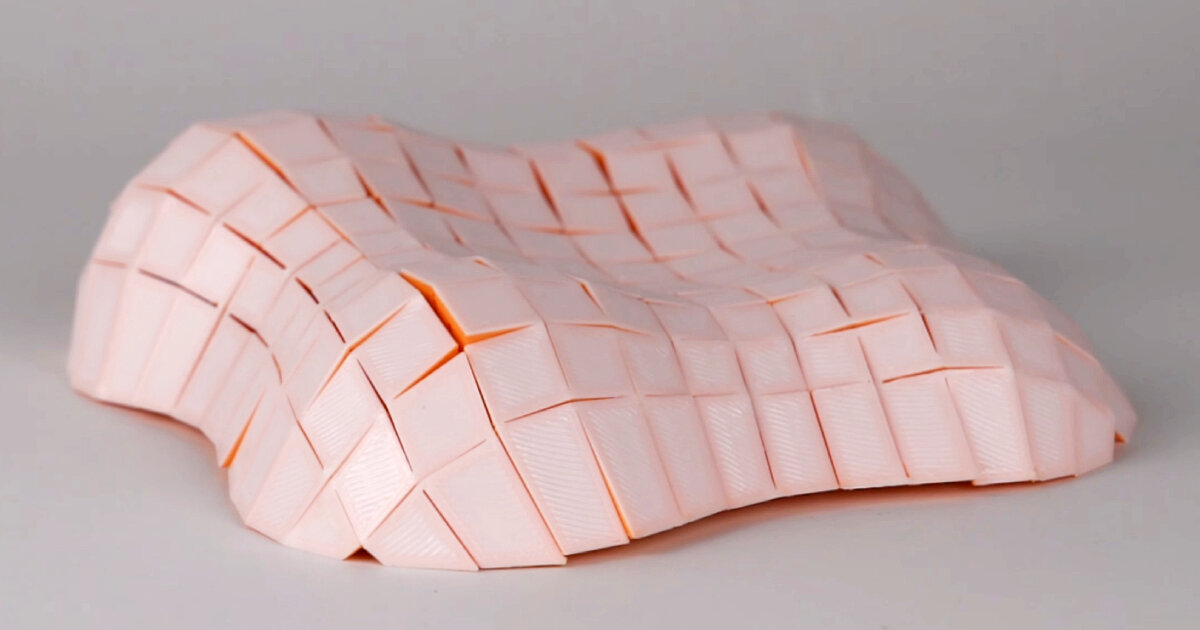
"The researchers begin with a user-defined 3D form, anything from a medical splint to a chair or a dome-like shelter. Their algorithm then translates this form into a flat object with interconnected quadrilateral tiles, linked by rotating hinges at the corners. They allow the modular emergency habitats to transition smoothly between flat and curved 3D states. The transformation is actuated not by motors or air pressure, but by tightening a single string routed through the structure."
"Researchers at MIT develop a method that turns flat objects into 3D modular emergency habitats by pulling a string. The purpose of the research is to create an easily deployable architecture for disaster zones and even space habitats and infrastructure on Mars. The team says that traditional deployable structures exist, but they are often manually designed, geometrically simple, and dependent on complex systems. They then set out to reduce that complexity by replacing multi-step assembly with a single pull."
A method turns flat objects into 3D modular emergency habitats and other complex forms using a single continuous string pull. Any user-defined 3D form can be translated into a flat layout of interconnected quadrilateral tiles with rotating corner hinges. The tiled sheet transitions smoothly between flat and curved 3D states when a routed string is tightened. The actuation avoids motors and air pressure, relying solely on the string. Pulling the string produces friction and uneven forces that risk incomplete deployment. A two-step optimization first computes the minimum lift points required for target shape, then computes a shortest string path that connects those points while guiding boundary tiles.
Read at designboom | architecture & design magazine
Unable to calculate read time
Collection
[
|
...
]