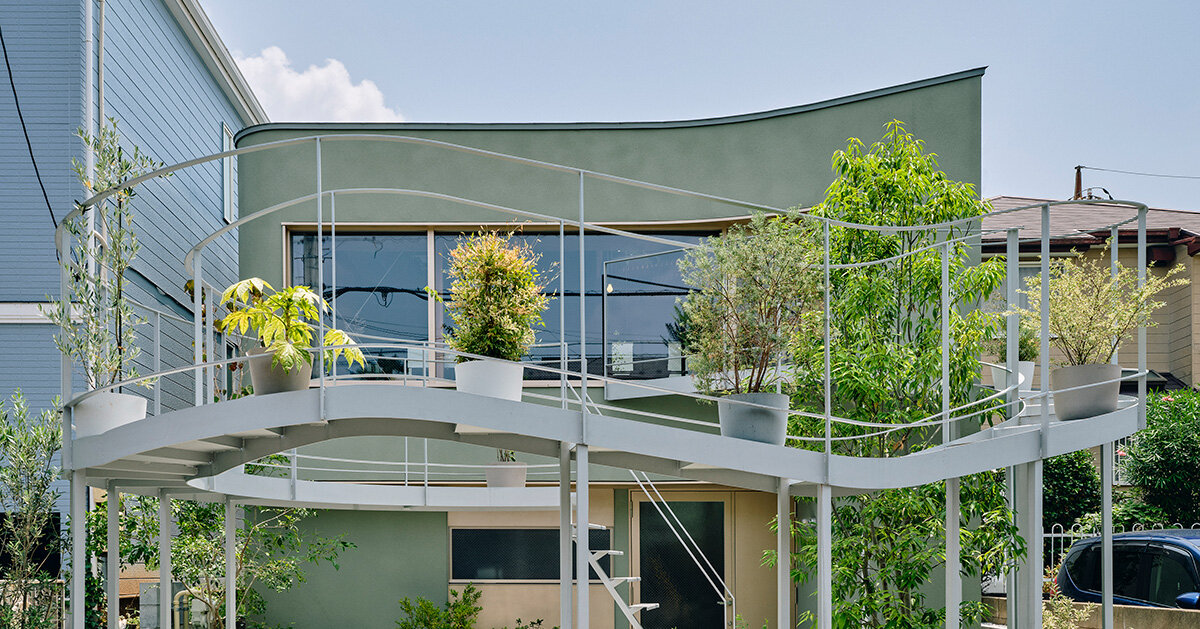
"With buildings pressed up against the property line on three sides, the only opening was to the north, usually the least generous orientation for daylight in Japan. Instead of treating that limitation as a flaw, the project turns it into a defining gesture through a looping, elevated terrace called the Kazari Garden, which arcs toward the street to catch sunlight and frame a borrowed view for the interior."
"The Kazari Garden stretches outward from a large second-floor window, curving along the road. Its smooth outline slips beyond the shadow of the house, allowing plants to thrive and daylight to spill into the dining space. Residents watering the terrace unintentionally strike up conversations with pedestrians, and passing children stop to watch. In this sense, the house behaves as a civic participant, an informal lookout, a micro-park, or a porch suspended above the street."
"Inside, the Japanese team at HOAA organizes the home through a split-floor system responding to the site's elevation change. Wood-clad interiors unfold in alternating views toward the Kazari Garden and the more protected Back Garden, creating a spiral circulation that continually reorients daily movement. Storage is displayed, with shelves lining the route, holding ceramics, books, photographs, and plants. The architects treat everyday belongings as lived archives, objects that introduce gentle friction and self-awareness, giving the home the atmosphere of a small, evolving art museum."
A 96.38-square-meter urban dwelling in Nakano serves as residence and workplace. Buildings press against the property line on three sides, leaving only a northern opening. A looping elevated terrace called the Kazari Garden arcs toward the street to capture sunlight and frame a borrowed view. The terrace slips beyond the house shadow, allowing plants to thrive and daylight to spill into the dining area while prompting conversations with pedestrians and playful onlookers. Internally, a split-floor system responds to site elevation, producing wood-clad, alternating views toward the Kazari and Back Garden and a spiral circulation lined with shelves displaying everyday belongings as lived archives.
#tokyo-infill-housing #kazari-garden-terrace #split-level-spiral-circulation #architecture-as-civic-space
Read at designboom | architecture & design magazine
Unable to calculate read time
Collection
[
|
...
]