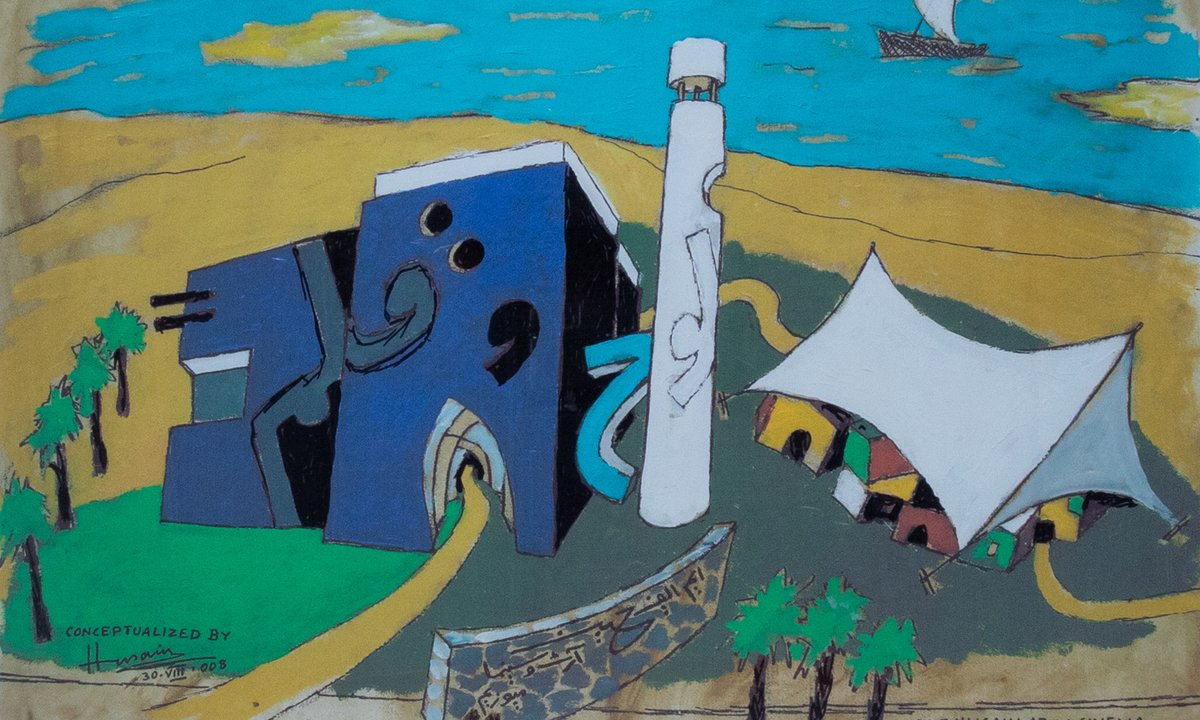
A design translates a drawing of a blue house and white tower into an architectural concept that reads cultural markers such as a sailboat, tent, and cityscape evoking Yemen and Indian incremental urbanism. The choice of blue tiles references Central Asian tiles and regional identities, while broken stone façades recall Husain's New Delhi home and the Husain Doshi ni-Gufa in Ahmedabad. Tiles function climatically and culturally, reflecting heat and holding regional narratives. The museum site relates to an existing cylindrical glass building, Seeroo fi al Ardh, containing Husain's last kinetic sculptural work that can serve as a museum entry or exit point.
"The literal reading is that there is a blue house and a white tower. But in our discussions during the early stages, we were thinking, what is the significance of blue? Is there a reference here to the tiles from Central Asia that came to South Asia? There is a sailboat in the backdrop. Does this indicate a space or the centuries-old trade relationship between South and West Asia?"
"The surface is blue tiles, which the sketch does not necessarily indicate. Some of the cues for us were that Husain designed a home in New Delhi with broken stone as a façade. And then, of course, the Husain Doshi ni-Gufa in Ahmedabad [an underground gallery of Husain's work, designed by the architect B.V. Doshi and now known as Amdavad ni Gufa]. That has broken tiles, which are a part of Indian architectural language:"
#architectural-translation #tiles-and-materiality #cultural-exchange-southwest-asia #site-specific-museum-design
Read at The Art Newspaper - International art news and events
Unable to calculate read time
Collection
[
|
...
]