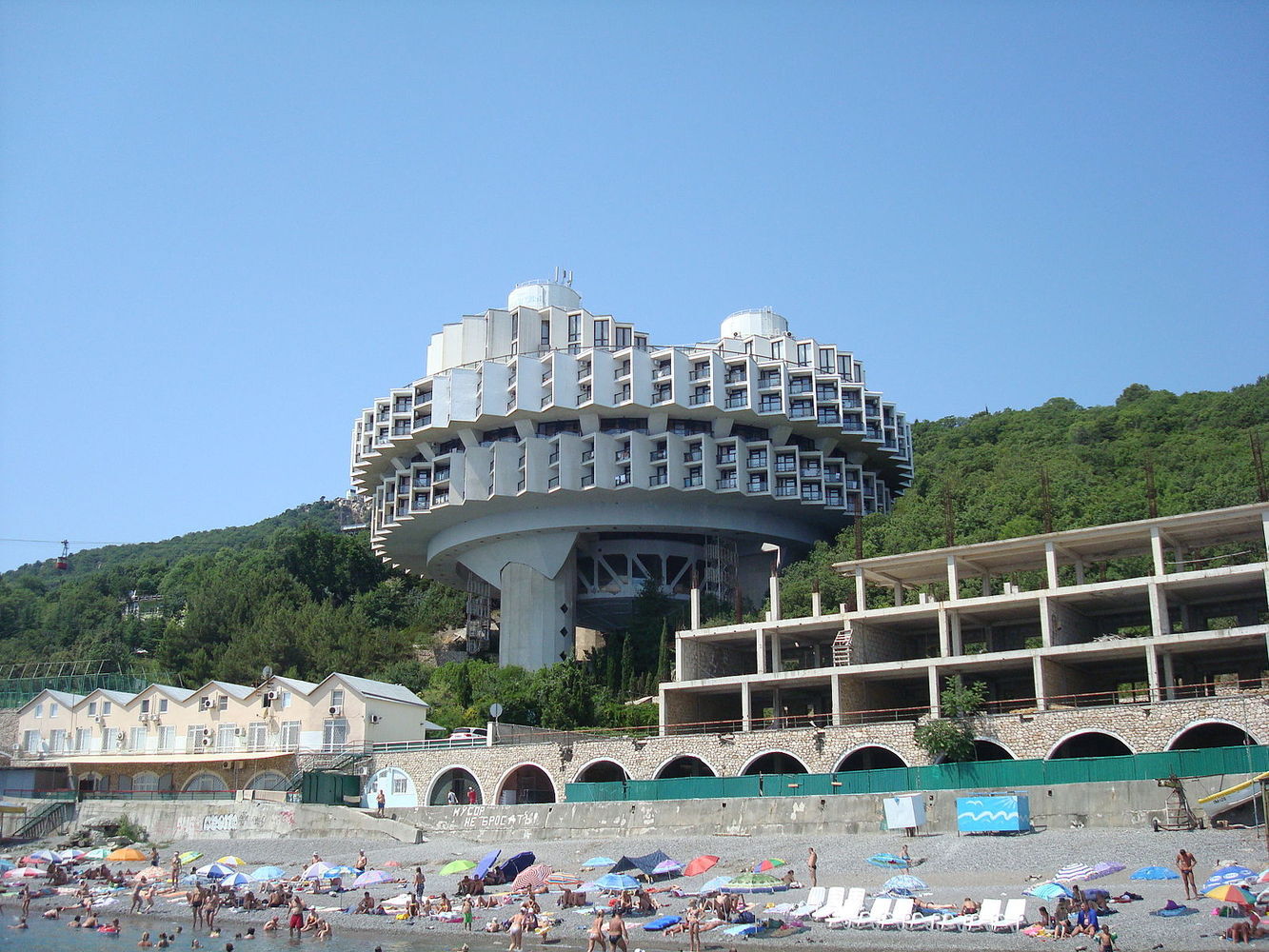
"Perched above the cliffs of Crimea, the Druzhba Thermal Sanatorium appears less as a building than as a landed spacecraft. Its circular forms, suspended decks, and spiraling ramps evoke a scene from Andrei Tarkovsky's Solaris (1972), where architecture and psychology merge into a single landscape. Built between 1978 and 1985 by Igor Vasilevsky, the complex was conceived as a thermal resort for workers of the oil industry, part of the Soviet Union's extensive network of sanatoria dedicated to health and recreation."
"Beyond its function as a place of recovery, Druzhba, meaning "friendship", embodied a broader political and aesthetic ambition. It sought to merge technological prowess with the restorative ideals of socialist modernity, translating collective well-being into concrete form. Rising from a steep coastal slope overlooking the Black Sea, its massive structure defies gravity, supported by a central concrete core from which radial wings extend like the blades of an enormous gear."
Perched above the Crimean cliffs, the Druzhba Thermal Sanatorium presents circular forms, suspended decks, and spiraling ramps that create a spacecraft-like silhouette. Constructed between 1978 and 1985 by Igor Vasilevsky, the complex served as a thermal resort for oil industry workers within the Soviet network of sanatoria for health and recreation. Named Druzhba ("friendship"), the project aimed to combine technological prowess with restorative socialist modernity, translating collective well-being into concrete form. The structure rises from a steep coastal slope around a central concrete core, with radial wings extending like gear blades, appearing both mechanical and organic.
Read at www.archdaily.com
Unable to calculate read time
Collection
[
|
...
]