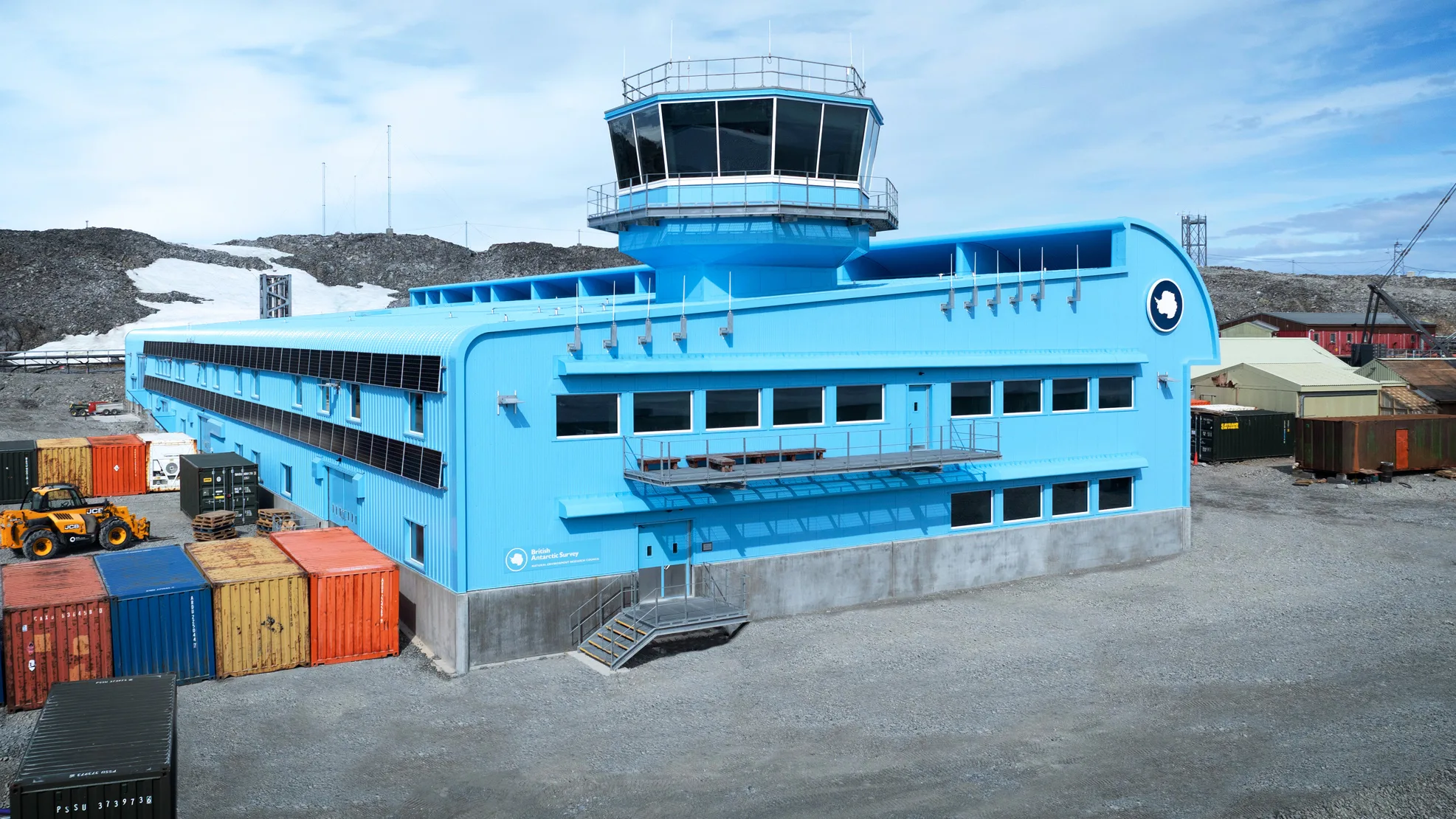
"Most notably: it sports an innovative feature called a wind deflector, which protrudes on the leeward edge of the building (the one sheltered from the prevailing wind) and prevents snow from piling up right next to the building. So far, the system has most commonly been used above doors to clear snow that would otherwise fall adjacent to the building, but the architects say it's never been used at this scale before. The feature could change the way we design buildings for harsh climates."
"The Discovery Building is located within Rothera Research Station-a center for marine and atmospheric studies and the UK's largest research facility in Antarctica. For years, the research station was spread across nine separate buildings, meaning researchers often had to navigate between them in blizzard conditions. Now, all functions are consolidated under one (very unique) roof, in a building that acts as the station's nerve center."
The Discovery Building sits on the southern edge of Adelaide Island on the Antarctic Peninsula, where coastal temperatures average 14°F. The two-story, nearly 50,000-square-foot facility is clad in highly insulated metal composite panels and uses a mono-pitch roof that slopes in one direction to shed snow. A wind deflector protrudes along the leeward edge to prevent snow from piling up adjacent to the structure; similar systems have typically been used above doors but not at this scale. The building consolidates functions previously spread across nine separate structures, reducing outdoor travel during blizzards and acting as a centralized nerve center.
Read at Fast Company
Unable to calculate read time
Collection
[
|
...
]