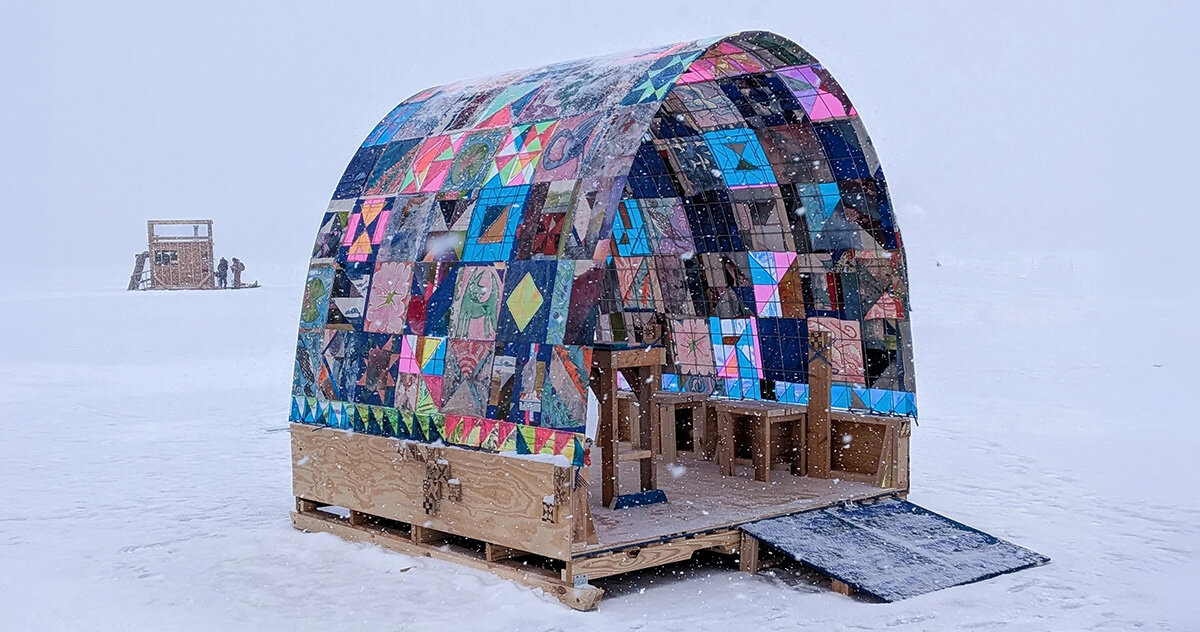
"From a distance, the curved profile reads as a familiar hoop house, the kind used in gardens and small farms to extend a growing season. Its arched ribs rise directly from the snow-covered lake, forming a simple tunnel volume. What distinguishes it is the skin. Instead of translucent plastic, a patchwork quilt stretches across the frame and wraps the structure in saturated blocks of color that register sharply against the white ice."
"The lightweight structure relies on evenly-spaced ribs and a tensioned outer layer, to create a stable enclosure with minimal material. That economy feels appropriate for a project sited on a frozen lake, where assembly and disassembly must remain efficient and responsive to weather conditions."
"Quandahl constructed the nine by sixteen foot quilt from studio remnants including painted canvas, vinyl, and drop cloth. The surface carries visible seams and varied textures, so the enclosure reads as both building envelope and textile composition. The patchwork does more than decorate the frame. It thickens the wall visually, giving the small shelter a sense of insulation and weight even though the structure itself remains light."
The Quilt Shanty is a public art installation by Emily Quandahl and Madeline Cochran on a frozen Minneapolis lake as part of the annual Art Shanty Projects program. The structure uses a hoop house frame—typically found in gardens and farms—as its architectural foundation, creating a lightweight, efficient shelter suitable for temporary installation on ice. The nine by sixteen foot quilt covering is constructed from studio remnants including painted canvas, vinyl, and drop cloth, featuring visible seams and varied textures. The patchwork design serves both aesthetic and functional purposes, creating visual thickness and a sense of insulation while drawing inspiration from barn quilts, the large painted quilt squares found on Midwestern agricultural buildings.
Read at designboom | architecture & design magazine
Unable to calculate read time
Collection
[
|
...
]