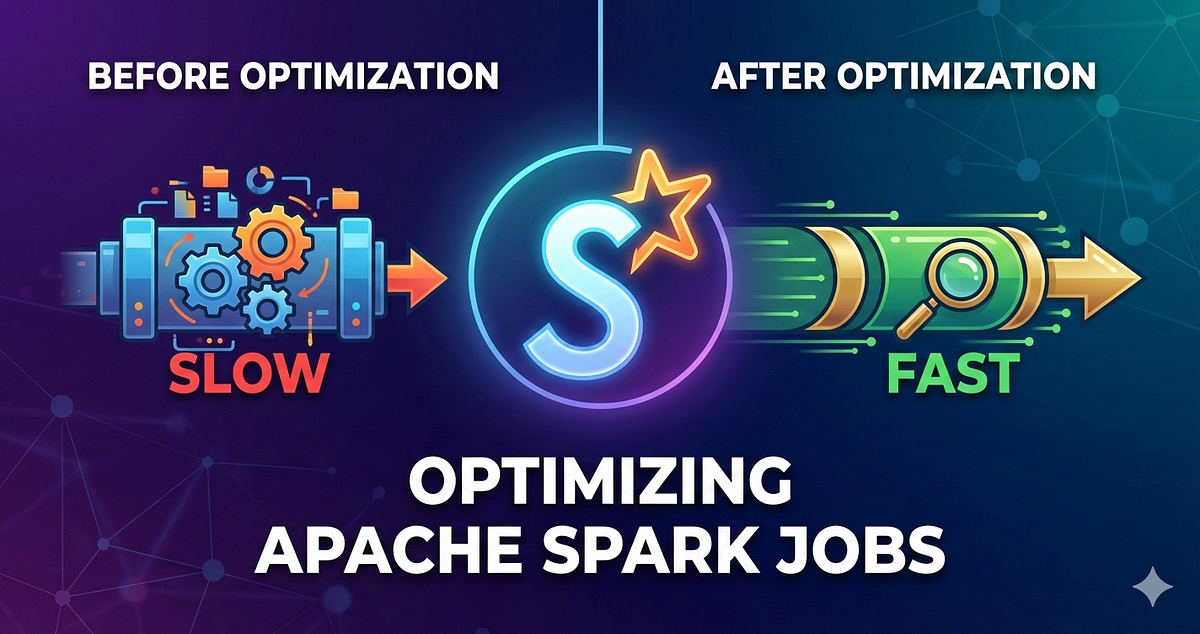
"Understanding Spark's Execution Model Before diving into optimizations, it's crucial to understand how Spark executes your code. Spark uses lazy evaluation - transformations aren't executed until an action is called. This allows Spark to optimize the entire execution plan. Key concepts: Stages: Groups of tasks that can be executed without shuffling data Shuffles: Expensive operations that move data across executors Use df.explain(True) to see your execution plan and identify bottlenecks: df.explain(True)# Shows: Parsed Logical Plan → Analyzed → Optimized → Physical Plan"
"The Golden Rule: Filter early, select early. pFilter Pushdown Spark can push filter predicates down to the data source (Parquet, JDBC, etc.), meaning you only read relevant data into memory. The key is to filter before performing expensive operations. Bad: Good: Even Better (with partition pruning): # If data is partitioned by date, Spark reads only relevant partitionsdf = (spark.read.parquet("s3://bucket/sales_data/") # Partitioned by date .filter(F.col("date") >= "2024-01-01") # Only reads Jan 2024+ partitions .filter(F.col("region") == "US")) # Then filter in memory"
Spark evaluates transformations lazily so actions trigger execution, enabling whole-plan optimization and visibility via df.explain(True). Execution consists of stages that run without shuffles, while shuffles are costly because they move data across executors. Filtering and selecting early reduces I/O and memory usage: push filters to data sources (Parquet, JDBC) to read only relevant rows and prune columns to avoid unnecessary reads. Combine partition pruning with column pruning to limit scanned partitions and columns. Choosing efficient join strategies is critical because joins often become the most expensive operations in Spark workloads.
Read at Medium
Unable to calculate read time
Collection
[
|
...
]