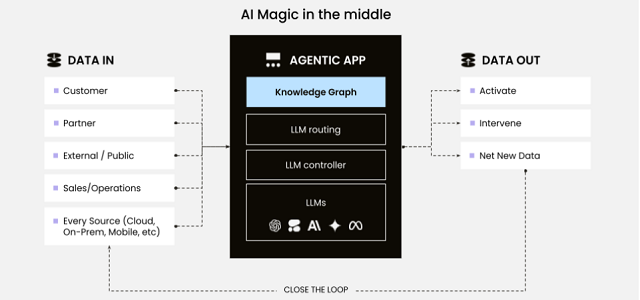
"Because proprietary data alone does not create leverage. It also requires a new architectural approach for agentic systems to work. What separates durable agentic systems from clever overlays is not the model. It is how context is assembled, governed, and activated, and next, how knowledge is shaped into something that can reason, act, and learn over time."
"The most successful AI-native design patterns emerging today share a common trait: centrally managed knowledge, operating across multiple organizational layers, with sub-agents deployed for specific roles and tasks. In this model, the knowledge graph is not a passive storehouse. It is the operating system for intelligence."
"Sub-agents do not ingest the entire graph. They receive precisely the slice of context relevant to their assignment. Nothing more, nothing less. This keeps agents focused, efficient, and interpretable, while allowing the system as a whole to remain expansive and adaptive. The architecture is intentionally fluid. Best practices evolve over time. But the principle holds: the system's primary function is to assemble the right information, for the right role, at the very moment it's needed."
"Knowledge graph-based systems are designed to give humans unprecedented leverage, not to remove them from the equation. The AI handle"
Durable value in the AI era comes from sensing and operationalizing data that cannot be scraped, copied, or commoditized. Enterprise knowledge graphs provide an operating system for intelligence rather than a passive database. Centrally managed knowledge spans multiple organizational layers, with sub-agents deployed for specific roles and tasks. Sub-agents receive only the relevant slice of context needed for their assignment, keeping agents focused, efficient, and interpretable while preserving an expansive and adaptive system. The architecture remains fluid as best practices evolve, but its primary function stays the same: assemble the right information for the right role at the moment it is needed. Human-AI collaboration is positioned as leverage rather than removal of humans.
#enterprise-knowledge-graphs #agentic-systems #data-governance #human-ai-collaboration #context-assembly
Read at Medium
Unable to calculate read time
Collection
[
|
...
]