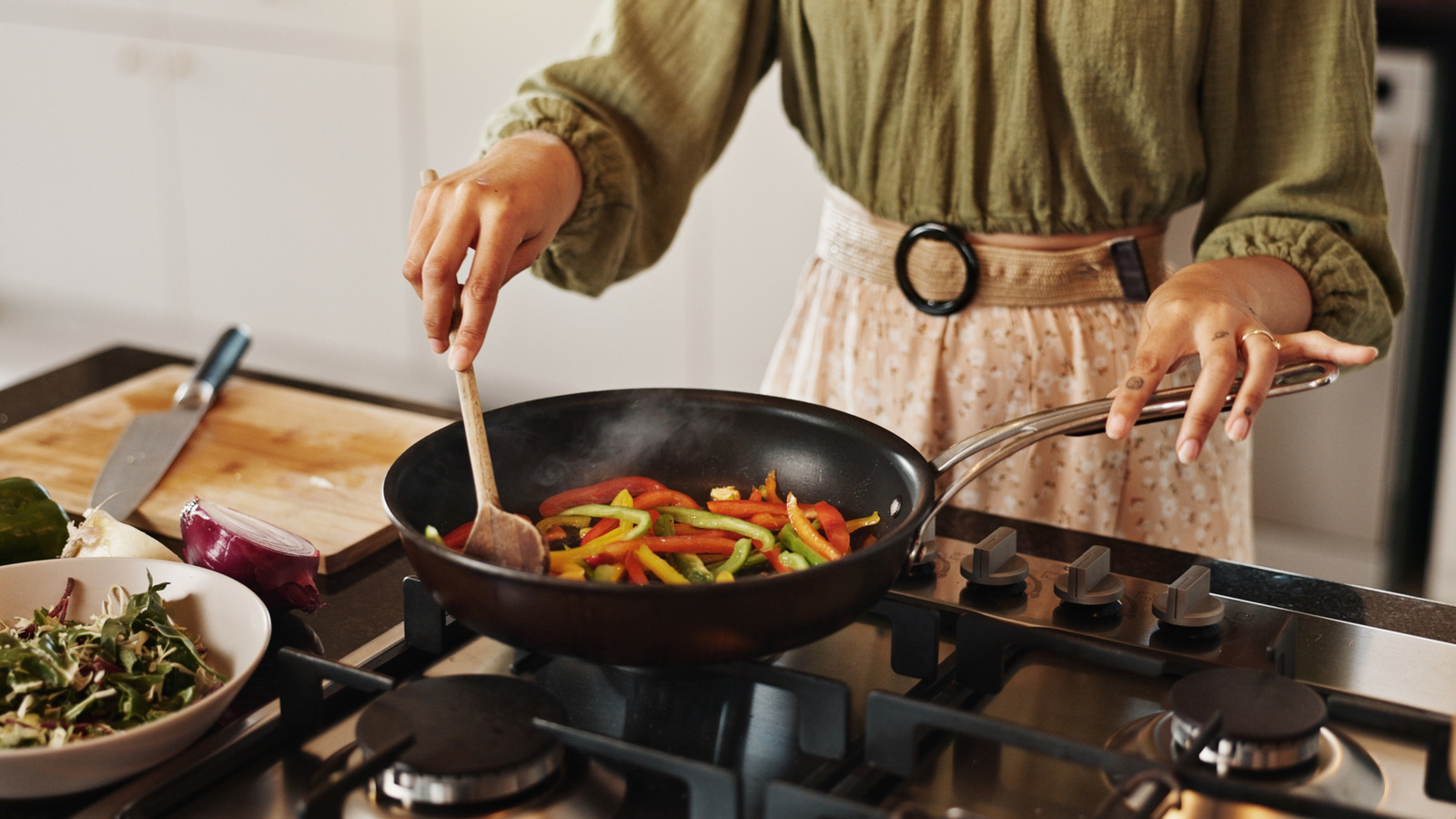
"When you put it on the stove top, maybe you have to adjust it to get it to sit as flat as possible. Otherwise, it'll wobble back and forth a little bit. The bottom has dark spots across its surface, and the metal is slightly warped and uneven after years of use. You may think this is just a symptom of your cookware getting older, a natural side effect of regular use, but the problem might be how you are using it."
"If you put your largest frying pan on your smallest burner, the heat is going to be concentrated in that limited area. That means the metal is going to heat up faster and hotter in one spot, while the rest of the pan remains cooler. Remember that the atoms in materials like metal expand when heated and contract when cooled. Because it's not heating evenly, this can cause the metal to warp."
Placing a large frying pan on a small burner concentrates heat in a limited area, causing the metal to heat and expand faster in one spot while other areas remain cooler. Uneven thermal expansion and contraction create stress that gradually warps the pan, especially if the pan is thin or low quality. A 2016 study in Applied Thermal Engineering found that pan material, thickness, and size strongly affect heat conduction efficiency. Preventive measures include ensuring the pan is no more than about an inch larger than the heating element, keeping cooktop and pan bottoms clean, and choosing higher-quality, thicker cookware.
Read at Tasting Table
Unable to calculate read time
Collection
[
|
...
]