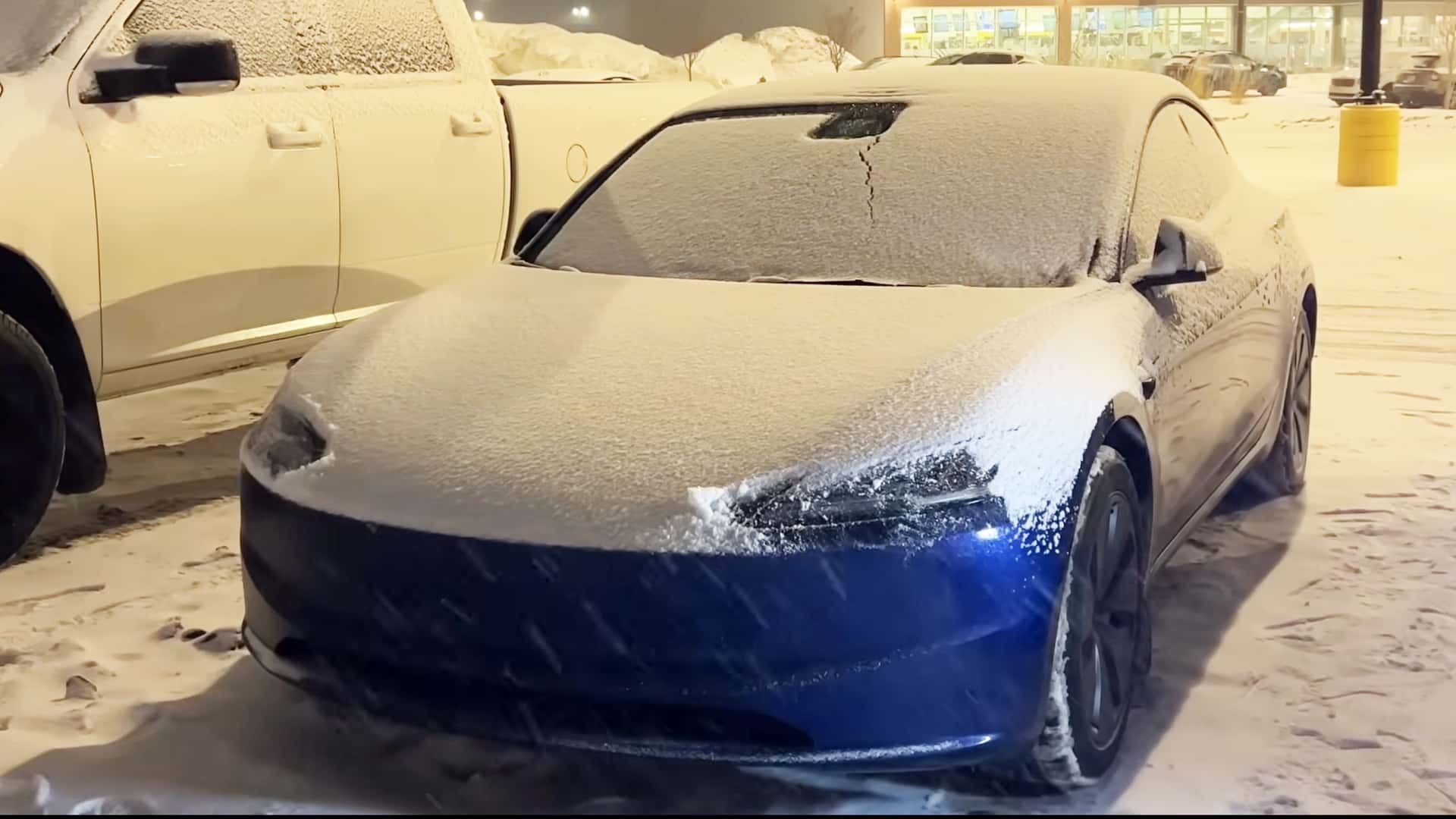
"So, he parked the car outside for 12 hours and noted the results. The cold soaking began at roughly 11 p.m., when the battery's state of charge was 80%. The car was put into Camping Mode, which keeps the climate control operational, and the HVAC was set to 60F (15.5C). That's not exactly toasty, but it should be enough to keep occupants safe from harm during a freezing night on the side of the road."
"After nine hours, the car had chewed through 30% of its battery. When the test ended after 12 hours, the battery's state of charge was down to 40%, which means the car used 40% of its battery to keep the cabin warm. The owner also checked to see if everything was still working as intended, and there were no issues whatsoever."
A Tesla Model 3 Long Range AWD was left running outside in −35°F (−37°C) conditions for 12 hours to measure cabin heating energy use. The test began with an 80% state of charge and used Camping Mode with the HVAC set to 60°F (15.5°C). After nine hours the battery had dropped by 30%, and after 12 hours the state of charge was 40%, indicating 40% battery consumption. All mechanical and electrical functions remained operational in the cold. Recharging the battery from 40% back to 80% required about 36 kWh, equating to roughly 3 kWh per hour and about $6.80 at U.S. average electricity rates.
Read at insideevs.com
Unable to calculate read time
Collection
[
|
...
]