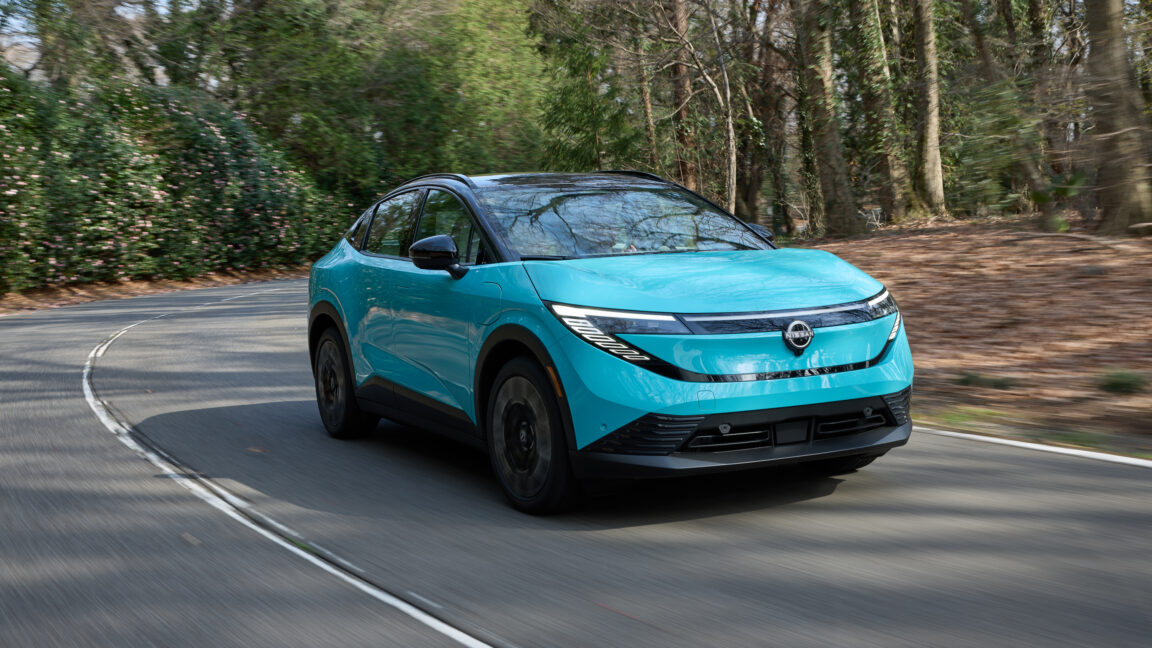
"Years before the Chevrolet Bolt or Tesla Model 3, the Nissan Leaf was a good-faith attempt by a major automaker to bring electric vehicles to the mass market. But even in its second-generation, the Leaf was hamstrung by poor battery management and was soon left behind. For its third take on the Leaf, Nissan fixed the earlier cars' key flaw by adding liquid-cooling for the battery pack."
"Our first drive of the car took place last year in San Diego, a region where the roads tend to flatter a car. Our first impression was positive enough to place the Leaf first among the cars we drove in 2025. Sure, if money were no object, I'd take that hybrid Porsche 911 that came in second, but you could buy five fully loaded Leafs for the same price as a bare-bones Carrera GTS."
The third-generation Nissan Leaf adds liquid-cooling to the battery pack and uses a dedicated EV platform that increases interior space and range efficiency. Current imports use a 75 kWh (usable) battery with a 214 hp (160 kW), 262 lb-ft (355 Nm) front-wheel-drive motor. Base S+ starts at $29,990; on 18-inch wheels it achieves a 303-mile (488 km) range but lacks heated front seats and a heat pump. The $34,230 SV+ adds heated seats, a heat pump, larger infotainment, more USB-C ports, wireless phone charging and LED turn signals. Initial San Diego impressions were very positive; extended testing evaluated daily use and cold-weather performance.
Read at Ars Technica
Unable to calculate read time
Collection
[
|
...
]