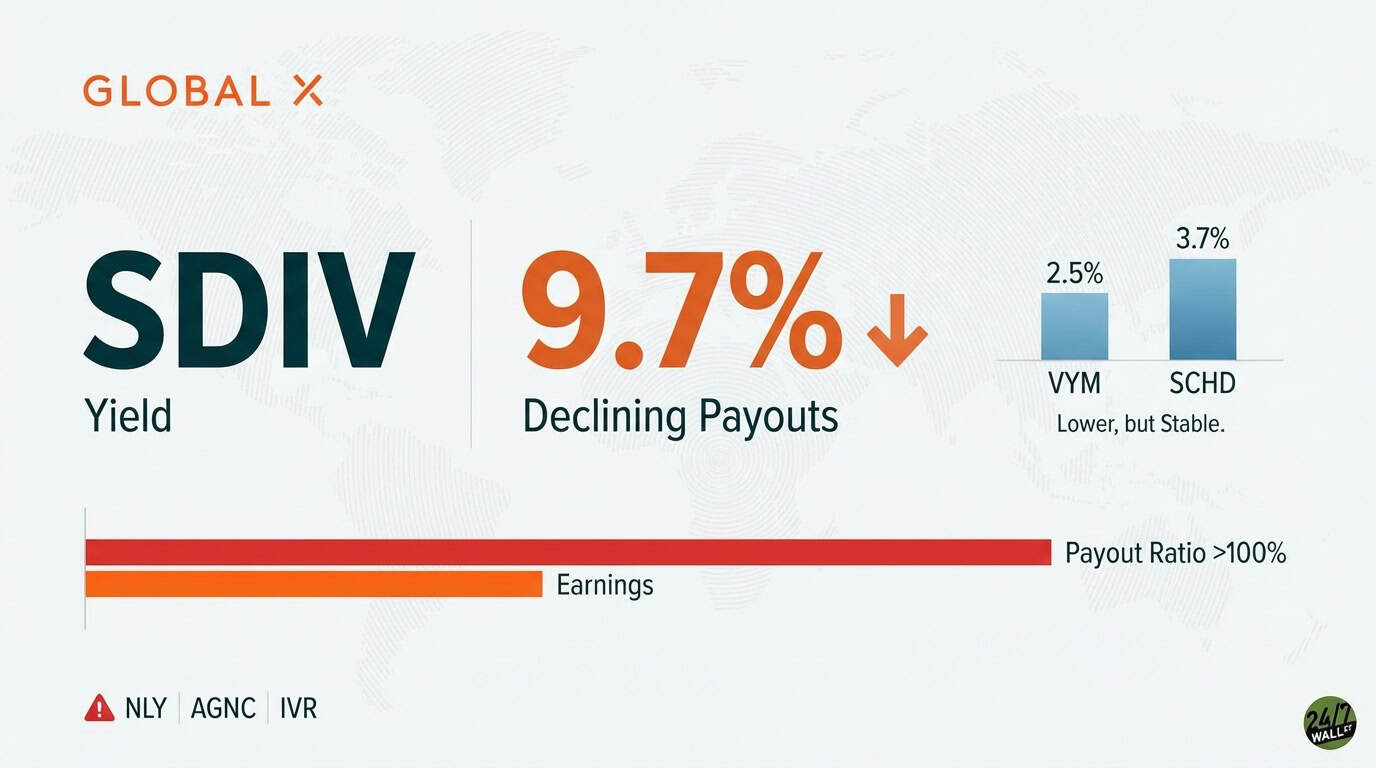
"The Global X SuperDividend ETF ( NYSEARCA:SDIV) delivers a 9.7% dividend yield, more than triple the 2.5% offered by the Vanguard High Dividend Yield ETF ( NYSEARCA:VYM) and over double the 3.7% from the Schwab U.S. Dividend Equity ETF ( NYSEARCA:SCHD). This international ETF tracks 100 of the world's highest-yielding equities, with significant exposure to mortgage REITs, Brazilian companies, and emerging markets. However, that exceptional yield comes with serious sustainability concerns."
"SDIV holds dividend-paying equities from global markets, with heavy concentration in mortgage REITs and international stocks. The fund's 0.58% expense ratio is nearly 10 times higher than VYM and SCHD, and its 93% portfolio turnover suggests frequent trading that can erode returns. The ETF's dividend has declined from $0.255 per month in early 2023 to $0.19 currently, representing a 25% cut that signals structural challenges."
"Annaly Capital Management ( NYSE:NLY), weighted at 0.91%, pays a 12.3% yield but has a 122% payout ratio, distributing $2.75 annually against earnings of just $2.26 per share. AGNC Investment ( NASDAQ:AGNC) at 0.85% weighting shows a 215% payout ratio, paying $1.44 against $0.67 in earnings. Invesco Mortgage Capital ( NYSEARCA:IVR) at 0.79% presents the most concerning profile, delivering a 17.4% yield with a 296% payout ratio."
SDIV yields 9.7%, far above typical large-cap dividend ETFs, by tracking 100 of the world's highest-yielding equities with heavy exposure to mortgage REITs, Brazilian companies, and emerging markets. The fund charges a 0.58% expense ratio, about ten times larger than some peers, and shows a 93% portfolio turnover rate that can erode returns. Monthly dividends fell from $0.255 in early 2023 to $0.19, a 25% reduction. Key mortgage REIT holdings have payout ratios well above 100% — Annaly 122%, AGNC 215%, Invesco Mortgage Capital 296% — reflecting leverage and rate sensitivity that threaten dividend sustainability despite recent spread improvements.
Read at 24/7 Wall St.
Unable to calculate read time
Collection
[
|
...
]