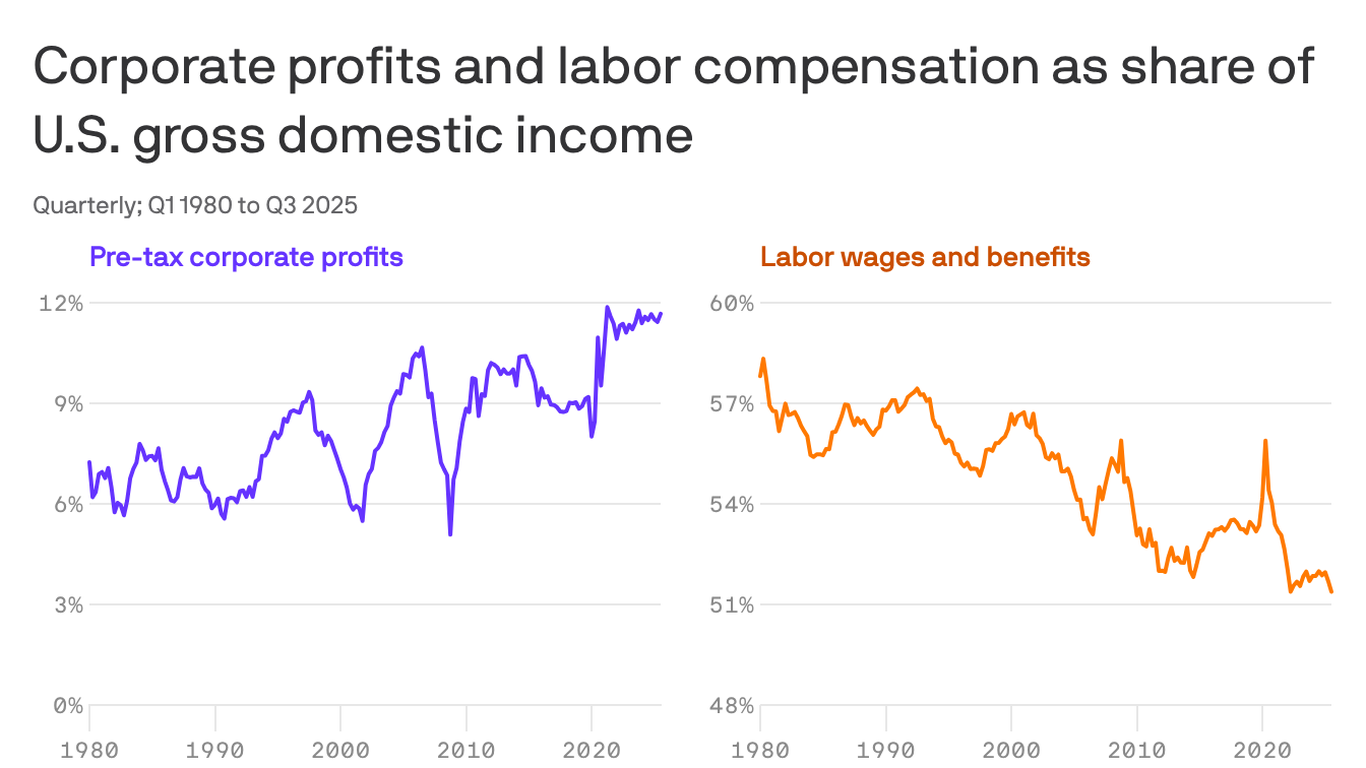
"The big picture: That disconnect between strong growth and comparatively anemic results for workers may sound like a unique challenge of 2026, but in fact, it is part of a longer-run phenomenon. Since the 1980s, the share of national income accruing to labor has fallen markedly, and the share going to capital has risen. There are technological and structural reasons for this, which the current AI boom looks poised to exacerbate."
"What they're saying: "The divergence between capital and labor helps explain the disconnect between a buoyant economy and pessimistic households," writes the Wall Street Journal's ace economic columnist Greg Ip. "It will also play an outsize role in where the economy goes from here." By the numbers: As Ip points out, the share of gross domestic income going to employees' wages and benefits was 51.4% in the third quarter, down from 58% in 1980."
Since 1980 the share of national income going to labor has fallen markedly, while the share going to capital has risen. Employee wages and benefits accounted for 51.4% of gross domestic income in the third quarter, down from 58% in 1980. Corporate profits rose from 7.2% to 11.7% over the same period. Technological change, the current AI boom, declining private-sector union power, and globalization are key drivers. If labor's share returned to 1980 levels, annual compensation would rise by about $2 trillion, roughly $12,000 per employed American. The unequal distribution helps explain persistent household pessimism despite solid macroeconomic growth.
Read at Axios
Unable to calculate read time
Collection
[
|
...
]