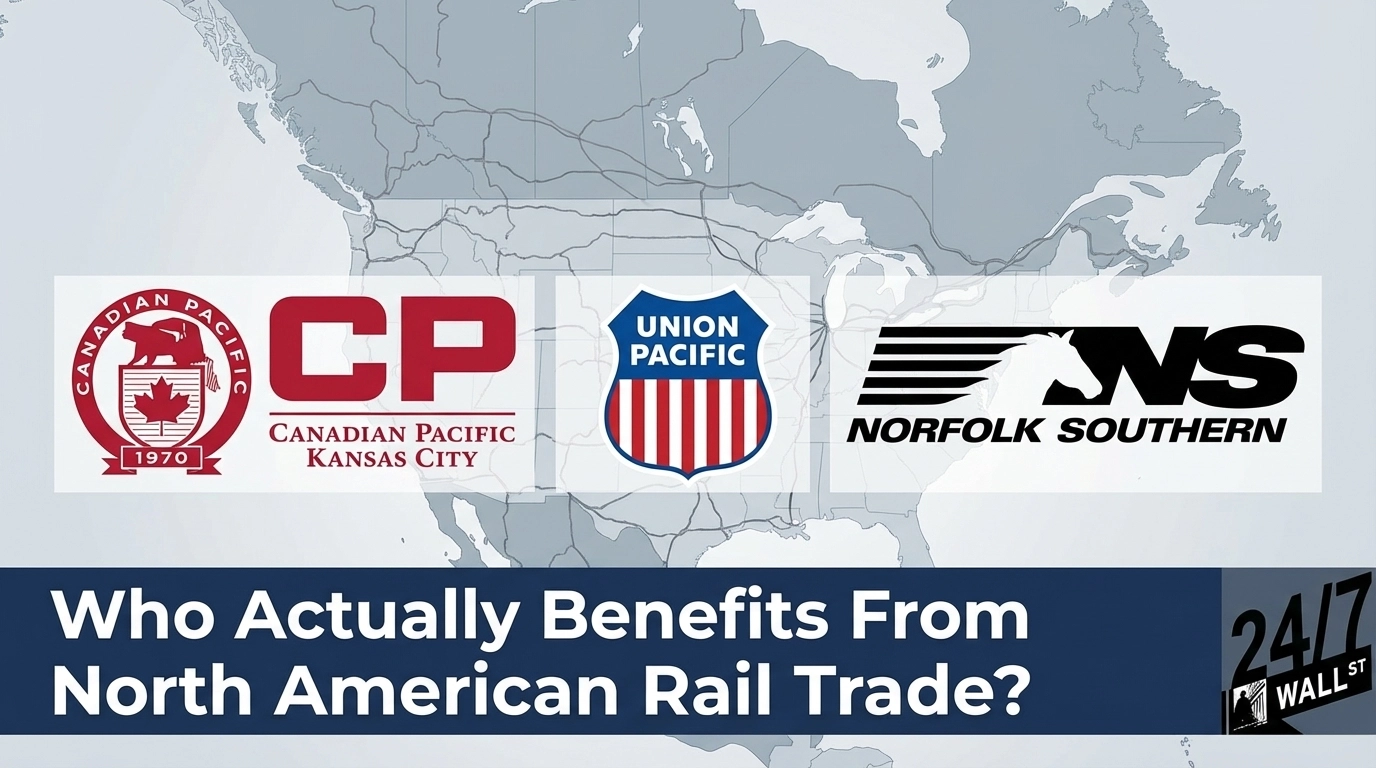
"North American freight rail is undergoing a quiet transformation. After decades of incremental consolidation, the industry now faces a strategic question: who benefits most from cross-border trade integration? The 2023 merger of Canadian Pacific and Kansas City Southern created the continent's only single-line Mexico-Canada-U.S. rail network. We looked at three major freight carriers to see who actually stands to benefit most from North American trade flows, despite all short-term political involvement in it."
"Canadian Pacific Kansas City ( NYSE:CP) operates a 20,000-mile transcontinental network spanning all three NAFTA nations. The company hauls bulk commodities (potash, coal, grain), intermodal containers, and automotive products. With a market cap of $67.89 billion and profit margins of 28.4%, CP generates $15.03 billion in annual revenue. The Kansas City Southern acquisition gave CP the only direct rail route connecting Canadian ports to Mexican manufacturing hubs without requiring handoffs to competing carriers."
North American freight rail consolidation has reached a point where network reach determines which carriers capture cross-border trade. The 2023 Canadian Pacific–Kansas City Southern merger created a single-line Mexico–Canada–U.S. corridor that avoids handoffs between competing carriers. Canadian Pacific Kansas City operates a 20,000-mile transcontinental network carrying bulk commodities, intermodal containers, and automotive products with strong margins and revenue. Union Pacific dominates western U.S. routes and West Coast intermodal flows but lacks an integrated single-line Mexico connection. Norfolk Southern serves the eastern U.S., relies on interchanges for Canada, and has limited direct Mexico exposure. Geographic reach and single-line connectivity shape competitive advantage.
#canadian-pacific-kansas-city #cross-border-rail-trade #north-american-freight-rail #intermodal-logistics
Read at 24/7 Wall St.
Unable to calculate read time
Collection
[
|
...
]