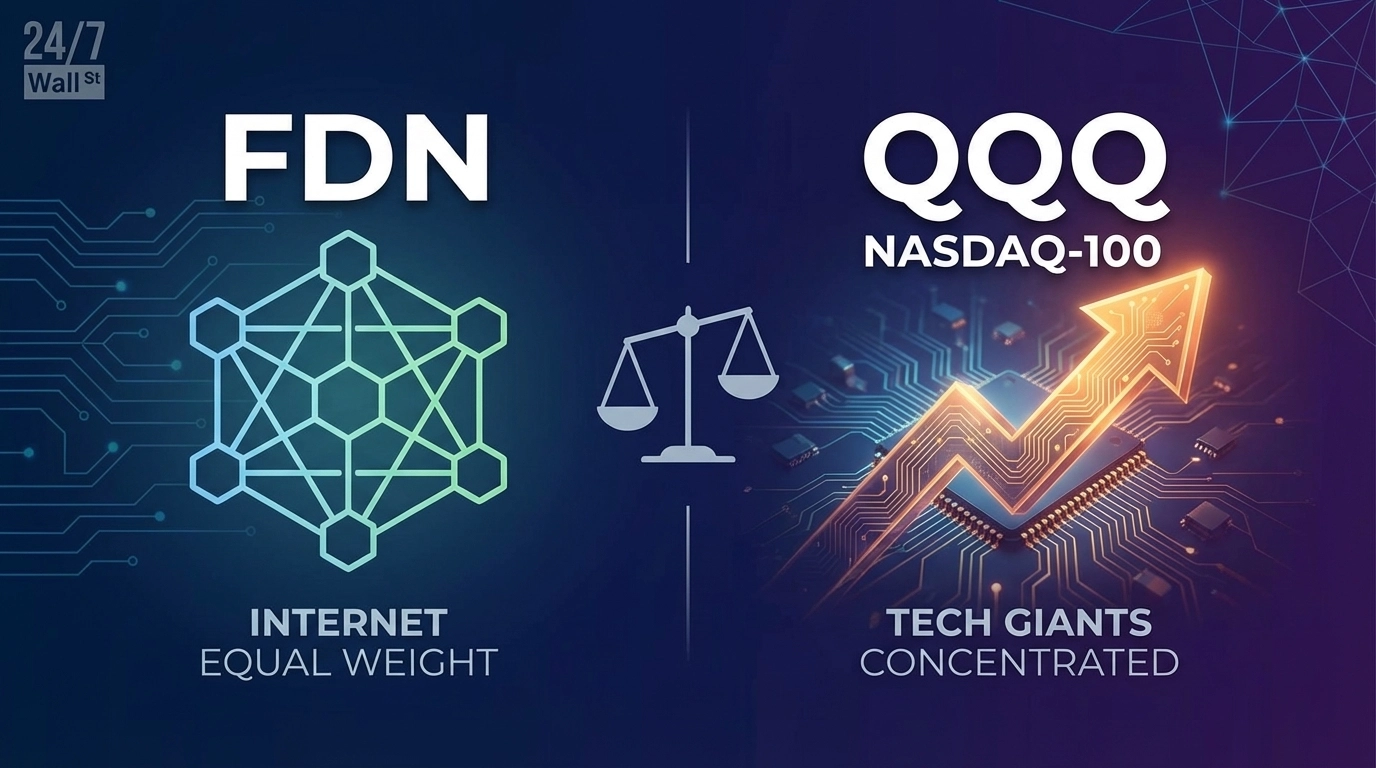
"FDN tracks the Dow Jones Internet Composite Index and holds 42 internet-focused companies with roughly equal weighting. The fund's largest holding, Meta Platforms ( NASDAQ:META), represents just over 10% of assets, compared to Nvidia ( NASDAQ:NVDA)'s 9% weight in Invesco QQQ Trust ( NASDAQ:QQQ). This provides exposure to companies like DoorDash ( NYSE:DASH), Snowflake ( NYSE:SNOW), Cloudflare ( NYSE:NET), and Carvana ( NYSE:CVNA) that play smaller roles or don't appear in QQQ."
"FDN bets that a basket of internet businesses will collectively benefit from digital economy growth without allowing any single company to dominate outcomes. The fund rebalances to maintain equal weights, automatically trimming winners and adding to laggards. This reduces the risk of overexposure to one company's missteps while capturing upside across the internet sector."
"Over the past year, FDN returned roughly 8%, which sounds modest until you compare it to QQQ's 18% return. The gap widens over longer periods, with QQQ's 97% return over five years versus FDN's 27%. The culprit: FDN lacks exposure to Nvidia, Apple ( NASDAQ:AAPL), and Microsoft ( NASDAQ:MSFT), which together represent 24% of QQQ. These three stocks drove much of the Nasdaq's recent outperformance, particularly Nvidia's AI-fueled surge. FDN's equal-weight approach also means it underweighted Amazon ( NASDAQ:AMZN) and Meta during their strongest periods while maintaining exposure to weaker internet names."
FDN tracks the Dow Jones Internet Composite Index and holds 42 internet-focused companies with roughly equal weights, with Meta Platforms as the largest holding at just over 10%. The fund rebalances regularly to trim winners and add to laggards, reducing single-company concentration and maintaining exposure across the internet sector including DoorDash, Snowflake, Cloudflare, and Carvana. FDN underperformed cap-weighted QQQ over one- and five-year periods because it lacks heavy exposure to Nvidia, Apple, and Microsoft and underweighted Amazon and Meta during their strongest stretches. The ETF charges a 0.49% expense ratio, higher than QQQ's 0.18%, increasing long-term cost for investors.
Read at 24/7 Wall St.
Unable to calculate read time
Collection
[
|
...
]