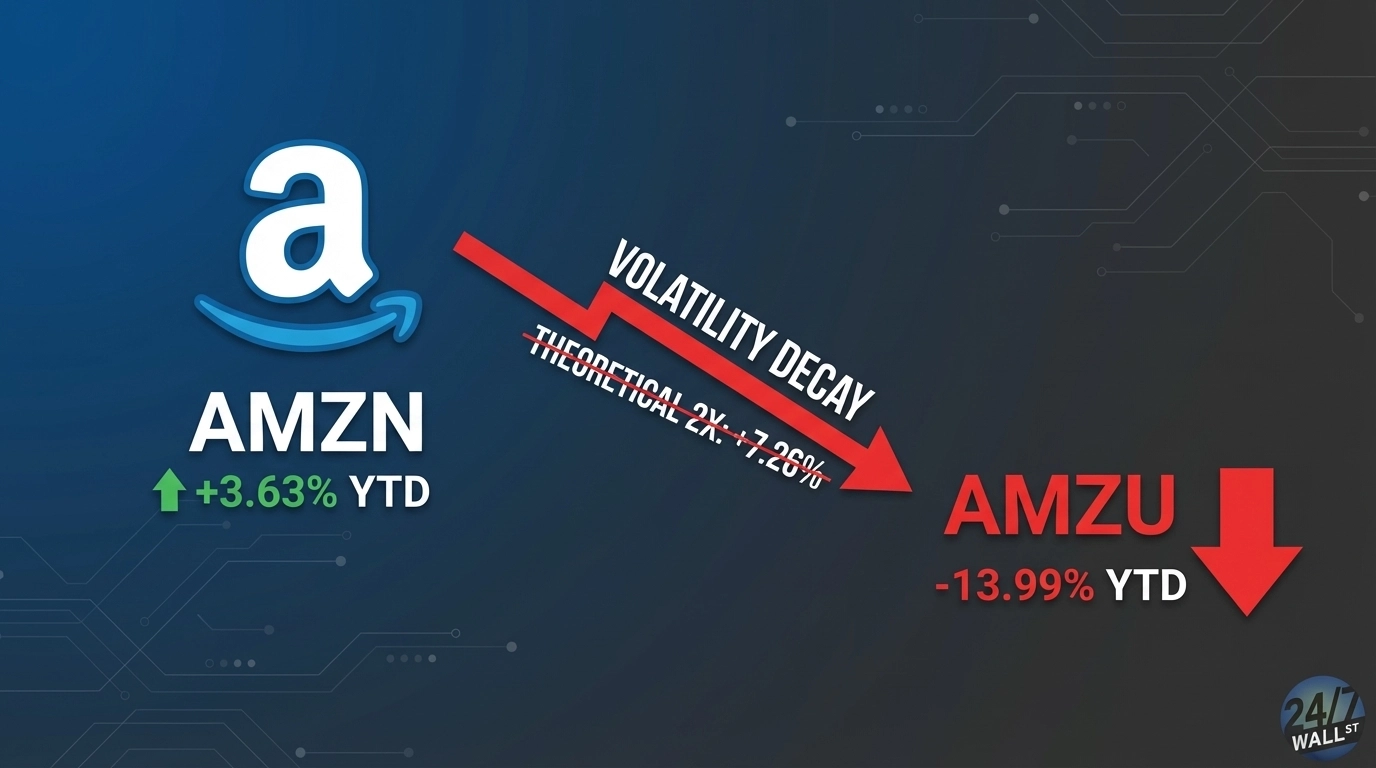
"AMZU doesn't generate income through traditional dividends. It uses derivatives, swaps, and daily rebalancing to achieve 200% exposure to Amazon's daily price movements. When Amazon pays a dividend, AMZU receives the distribution amplified through leverage, but at significant cost. The ETF paid a $1.20 special dividend in December 2025, but this must be evaluated against substantial NAV erosion from volatility decay."
"While Amazon declined 1.64% over the past year, AMZU lost 23.15% - nearly 20 percentage points beyond what 2x leverage predicts. The S&P 500 gained 12.63% and the Nasdaq-100 surged 20.70% over the same period. Year-to-date through December 2025, Amazon gained 3.63%, which should theoretically produce a 7.26% return for AMZU. Instead, the fund lost 13.99% - a 21-percentage-point shortfall from volatility decay. This occurs because daily resets lock in losses during choppy markets."
AMZU provides 200% daily exposure to Amazon using derivatives and daily rebalancing rather than holding equivalent direct equity. The fund held only 13.57% in Amazon stock, with the remainder in derivatives to achieve leverage, and it resets leverage daily. Daily resets create compounding drag and volatility decay that erode NAV and long-term returns even when Amazon appreciates. Over the past year Amazon fell 1.64% while AMZU fell 23.15%; year-to-date through December 2025 Amazon gained 3.63% while AMZU lost 13.99%, showing severe underperformance versus 2x expectations. Large daily swings in December 2025 amplified rebalancing losses. A $1.20 special dividend was paid in December 2025 but must be weighed against NAV erosion.
Read at 24/7 Wall St.
Unable to calculate read time
Collection
[
|
...
]