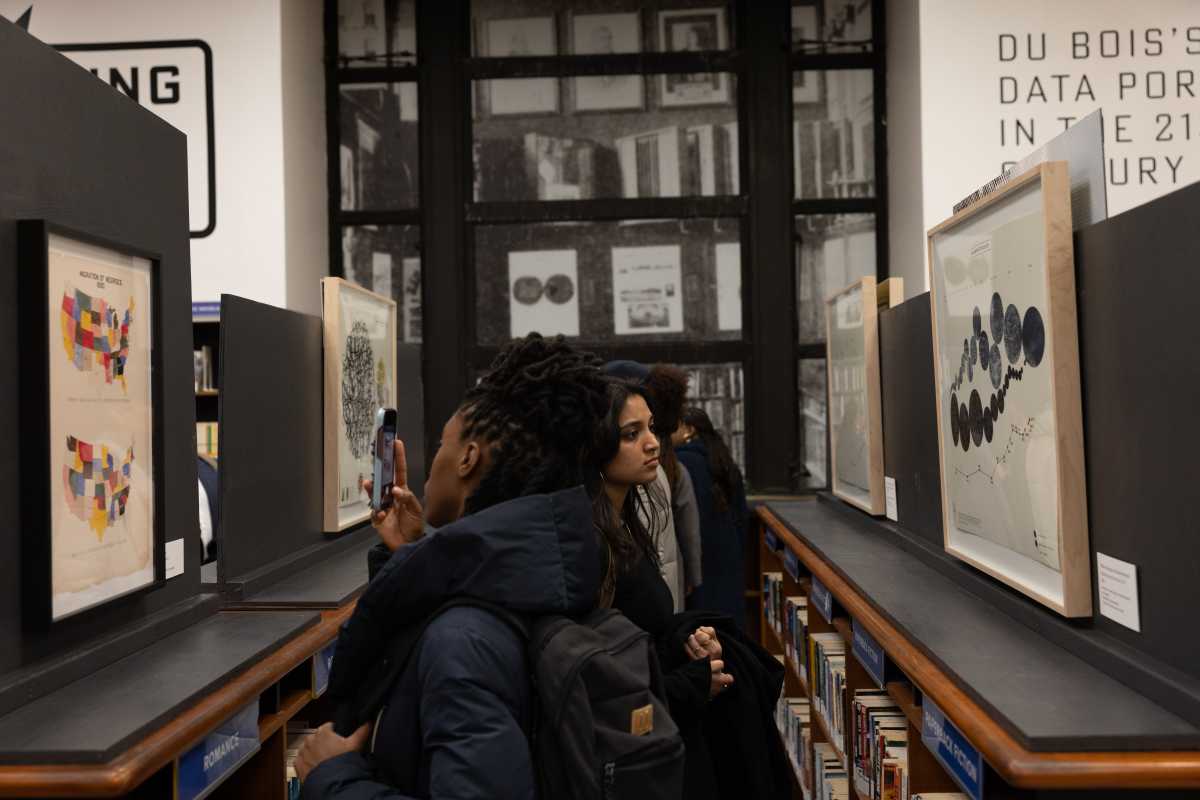
"We're trying to both highlight Du Bois's work but talk about it in the context of a living archive. The questions and inquiries that Du Bois brought up about Black life in America are still very much relevant and evolving."
"For the original "Exhibit of American Negroes," Du Bois, who lived in Brooklyn from 1951 to 1961, hand-drew infographics based on data collected in handwritten surveys and limited national data on Black lives in the U.S. census."
"Relying on Du Bois's trenchant data analysis, the original work visualized the "color line," delineating where rapid post-slavery advancements in the socio-economic realities of Black Americans took the form of progress concerning literacy rates, occupational shifts and property ownership."
W.E.B. Du Bois created hand-drawn infographics for the 1900 Exhibit of American Negroes, visualizing data on Black American literacy rates, occupational shifts, and property ownership during the post-slavery era. Over 125 years later, urbanist Shraddha Ramani and visual artist William Villalongo reimagine Du Bois's work in the Brooklyn Public Library exhibition "Printing Black America: Du Bois's Data Portraits in the 21st Century." The contemporary project presents historical source material alongside new works created with scholars, sociologists, and Black thinkers, using mechanical reproduction techniques from Du Bois's era. The exhibition highlights how Du Bois's inquiries about Black life in America remain relevant and continue evolving, treating the work as a living archive that addresses persistent racial disparities.
#data-visualization #black-american-history #web-du-bois #contemporary-art-exhibition #social-inequality
Read at Brooklyn Paper
Unable to calculate read time
Collection
[
|
...
]