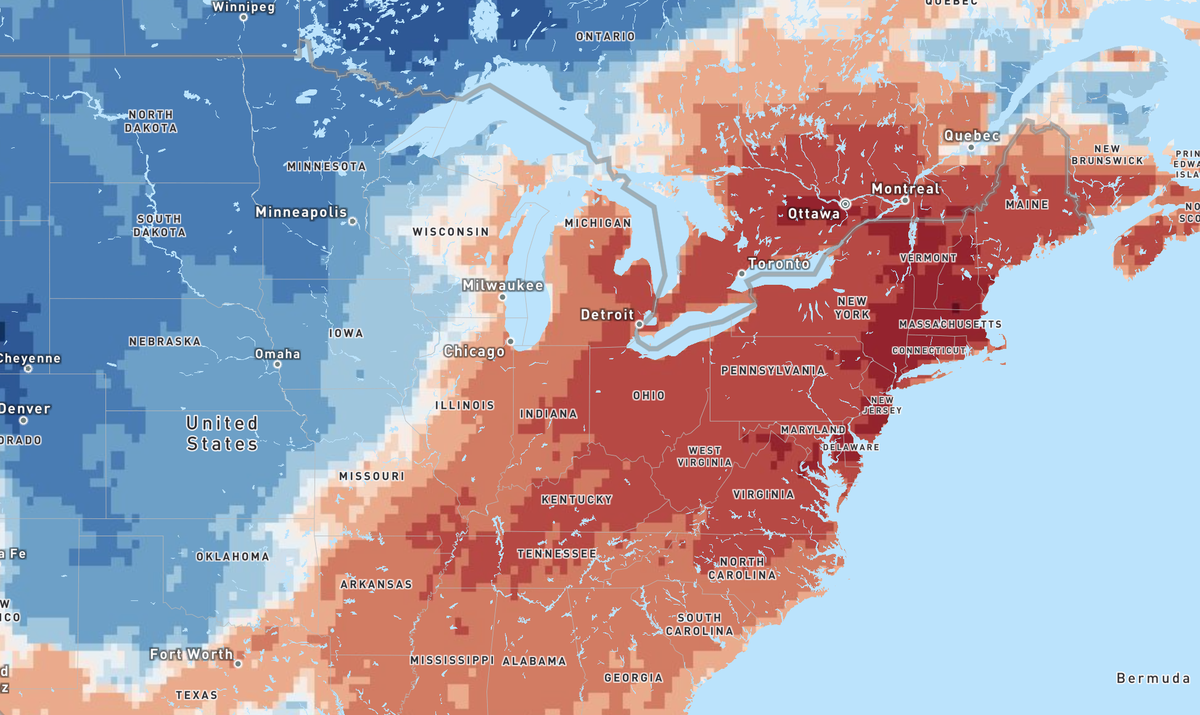
"Boston hit 96 degrees Fahrenheit on Tuesday, breaking the record for the date of 90 degrees F, set back in 1949. Dulles Airport near Washington, D.C., hit 94 degrees F, surpassing the previous record for May 19 of 92 degrees F. And Philadelphia reached 96 degrees F on Monday, besting the record of 94 degrees F set in 1962."
"The cause of the roasting heat is a weather system that always accompanies a big spike in temperatures: a high-pressure ridge. In this specific case, the system is called the Bermuda high, a semipermanent area of high pressure hanging out over the Atlantic Ocean to the east of North America that is also one of the atmospheric features that steers summer hurricanes. The clockwise flow of air around the Bermuda high pulls up warm, humid air from the south."
"This heat wave is not as intense as the one that sent temperatures soaring well into the triple digits in the Southwest in March, but it's still bringing temperatures into the 90s Fahrenheit from the mid-Atlantic to the Northeastwell ahead of average. Humidity is also rising, with dew points in the 60s Fthat's not as sweltering as they can be in the dog days of summer is the highest they have been so far this year, says Marc Chenard, a meteorologist at the National Weather Service's (NWS's) Weather Prediction Center."
"Though this week's temperatures won't challenge any all-time record highs, they still pose a health risk because people are less acclimated to heat this early in the year. The NWS's HeatRisk map tool shows maj"
Mid-May temperatures in the eastern half of the country are reaching midsummer levels due to an early heat wave. Boston recorded 96°F, Dulles Airport near Washington, D.C., reached 94°F, and Philadelphia hit 96°F, each surpassing prior May records. The heat comes from a high-pressure ridge known as the Bermuda high, a semipermanent high-pressure area over the Atlantic that helps steer summer hurricanes. Clockwise airflow around the ridge pulls warm, humid air northward from the south. Humidity is also increasing, with dew points in the 60s°F. Even without matching all-time highs, early-season heat poses health risks because people are less acclimated.
Read at www.scientificamerican.com
Unable to calculate read time
Collection
[
|
...
]