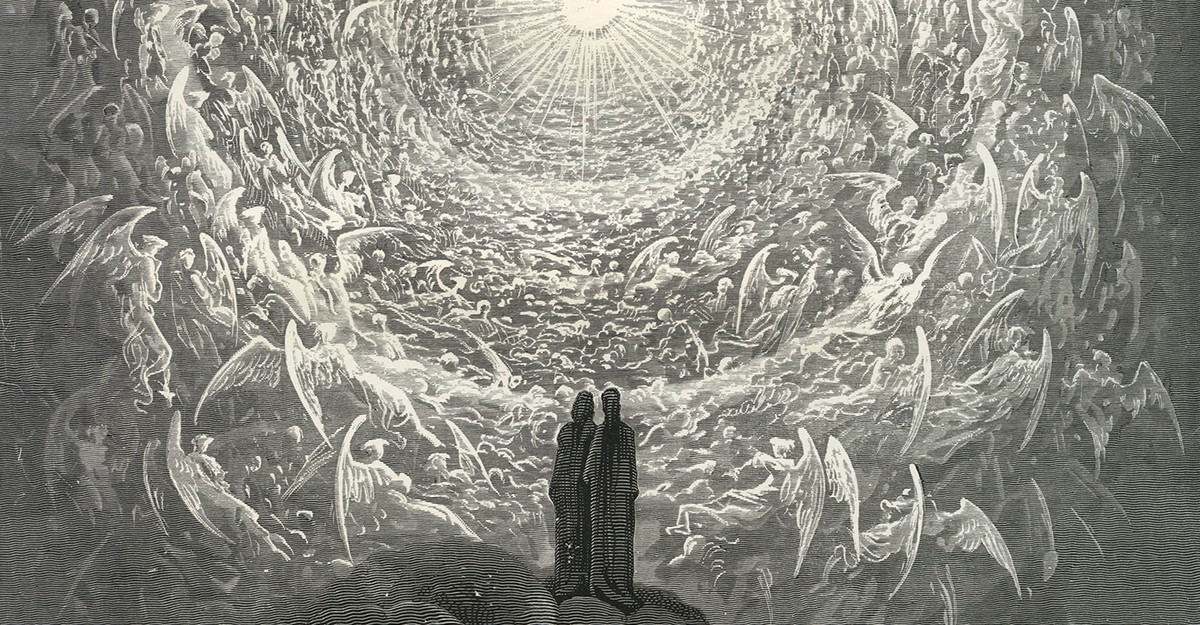
"Who can blame Dante's admirers when hell is filled with so many beautifully flawed characters: Francesca da Rimini, the eloquent adulteress; Farinata, the proud heretic; Ulysses, the defiant king; Ugolino, the father turned cannibal who ate his own sons? And then there are the infernal workers who make sure that Lucifer's realm runs smoothly, among them farting devils, giants in chains, and a flying monster with the body of a serpent and the face of an honest man."
"But Dante's journey has just begun. In Purgatorio, he must summit a massive mountain. Success in that struggle leaves him facing, along with other sinners, a wall of flames that inflict purifying pain but not death. Only then does Paradise await-and it's not just around the corner. He must travel past the planets and fixed stars to a rose-shaped empyrean."
The Divine Comedy exceeds 14,000 lines and divides into three parts. Inferno attracts the most attention and contains many memorable, morally complex characters such as Francesca da Rimini, Farinata, Ulysses, and Ugolino. Gustave Doré produced elaborate mid-19th-century engravings and devoted 99 of 135 images to Inferno's darkest scenes. Inferno features grotesque infernal workers—farting devils, chained giants, and a flying monster with a serpent's body and an honest man's face. Purgatorio involves a strenuous ascent of a massive mountain and passage through purifying flames that do not kill. Paradiso requires travel past planets and fixed stars to a rose-shaped empyrean, guided by Beatrice, and culminates in the coined experience trasumanar; Paradiso combines dense theological material with vivid visionary scenes.
Read at The Atlantic
Unable to calculate read time
Collection
[
|
...
]