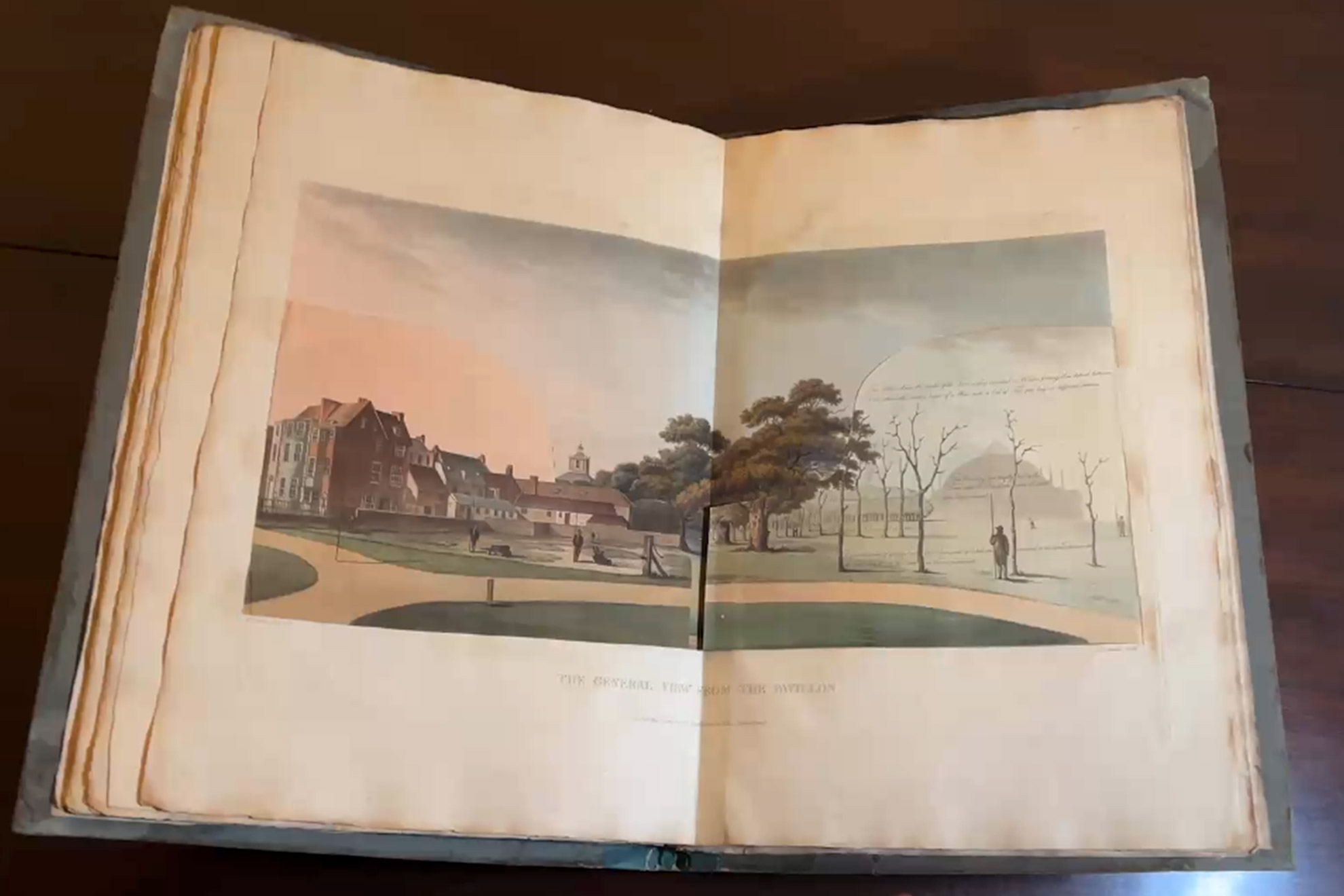
"Similar to Remmelin's book, English landscape designer Humphrey Repton created hundreds of books that feature layered images - capturing the before and after of proposed landscape changes for homeowners to preview his work. In Harvard's collection are design proposals for the Prince of Wales and his Brighton estate as well as the proposal for Mosely Hall near Birmingham - residence of wealthy Englishman John Taylor. Repton created more than 400 of these works throughout his decades long career spanning the late 18th century"
"The Gazette, with the help of Harvard librarians, explored a handful of titles that bring their subjects off the page. Layers of knowledge Older than Houghton Library itself, "Catoptrum Microcosmicum" or "Mirror of the Microcosm" is a medical textbook published in 1619 by the German physician Johann Remmelin. Perhaps intended for curious laypeople interested in anatomy, or medical students familiarizing themselves with the human form, Remmelin's book features dozens of ornate drawings of human bodies."
Harvard's collections include Catoptrum Microcosmicum (Mirror of the Microcosm), a 1619 medical textbook by Johann Remmelin containing dozens of ornate anatomical drawings. Humphrey Repton produced more than 400 layered flap books that present before-and-after landscape views; Harvard holds proposals for the Prince of Wales' Brighton estate and Mosely Hall near Birmingham. The libraries preserve early tactile books predating braille, including John Alston's raised Roman "Alston Type" invented in 1838. A circa-1840 broadside, The Glasgow Cathedral, is printed in Alston type with an embossed vignette. These works illustrate historical use of interactive images, movable elements, and raised type to enhance visual and tactile engagement.
Read at Harvard Gazette
Unable to calculate read time
Collection
[
|
...
]