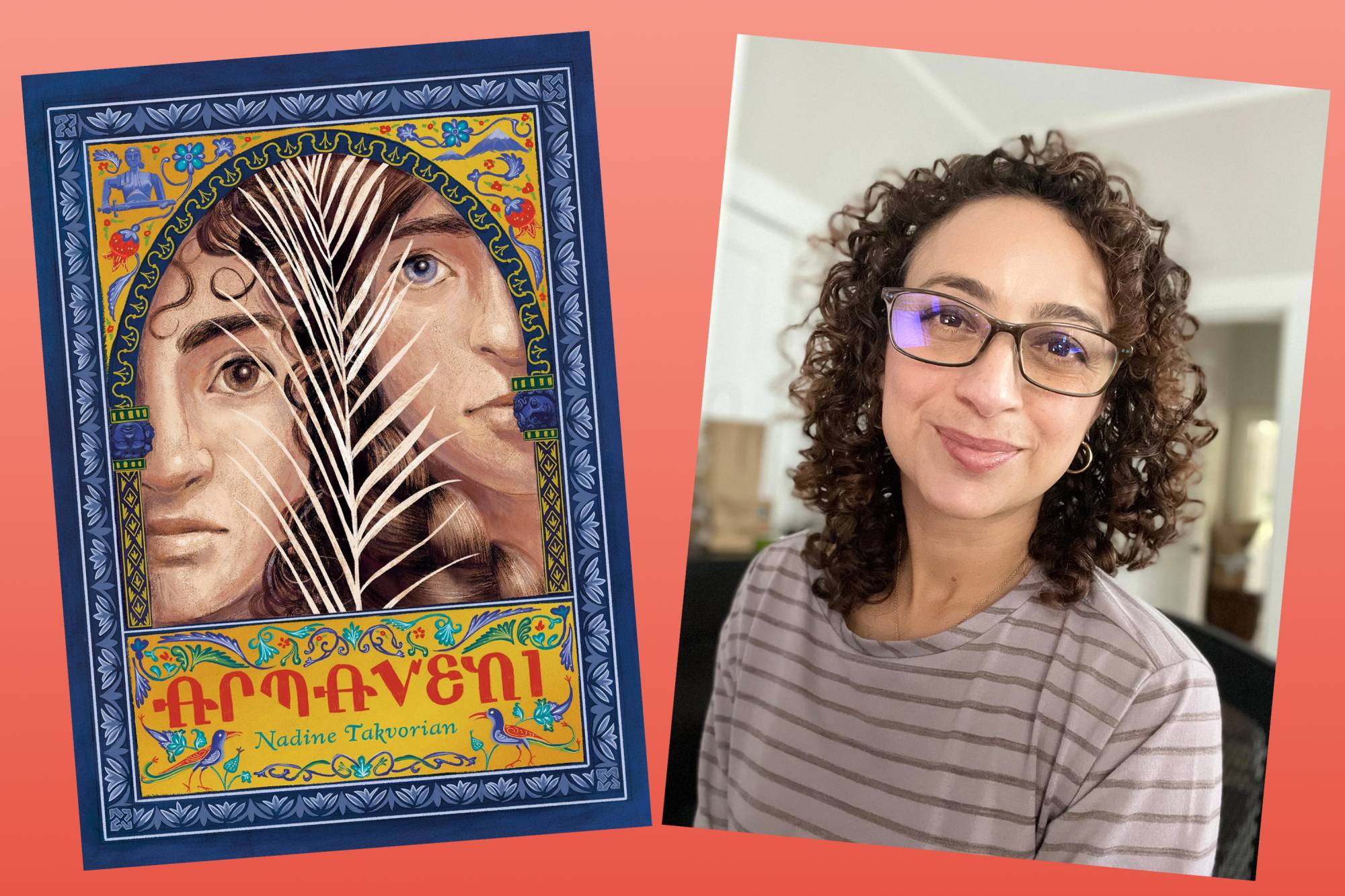
"In Armaveni, Nadine works occasionally at the shop, showcasing her industriousness and cultural curiosity. An inquisitive young girl, she pesters her parents to explain why her grandmother's eyes "are always so sad" until one day they acquiesce and unfold her backstory. The book moves back and forth through time from Nadine's perspective as a schoolgirl who has a homeland she's never visited and her grandmother Armaveni's perspective as a young girl in Hayastan (Armenia) living through the Meds Yeghern or "Great Catastrophe" during WWI."
"Though she began her career working in the children's educational market, and has worked on projects like a richly color-saturated Beowulf comic adaptation for kids, Takvorian's first graphic novel is not in full color. "The subject matter required more restraint," the author explains. The pages are covered in a lavender wash that gives them an archival feel, in line with the book's theme of an old family story being dusted off and recounted."
"Though Armaveni is a memoir of her family's story, the heart of the novel is Nadine's discovery of this persecution, which Armenians identify as a genocide, and the frustrations she feels when she realizes her parents do not wish to discuss it. Many deny it ever happened, including one of her American schoolteachers, and the country that perpetrated it, Turkey."
Nadine Takvorian, a Bay Area illustrator, has released Armaveni: A Graphic Novel of the Armenian Genocide, fulfilling a 27-year-old aspiration to document her Armenian diaspora experience. The autobiographical work alternates between Nadine's perspective as a curious schoolgirl discovering her homeland's tragic history and her grandmother Armaveni's experiences during the Meds Yeghern (Great Catastrophe) in WWI Armenia. Using a restrained lavender-washed aesthetic rather than full color to convey the gravity of the subject matter, the novel explores Nadine's frustration upon learning that many, including her parents and American institutions, deny or refuse to acknowledge the Armenian genocide. The work centers on her personal discovery of this persecution and the family dynamics surrounding its discussion.
Read at Kqed
Unable to calculate read time
Collection
[
|
...
]