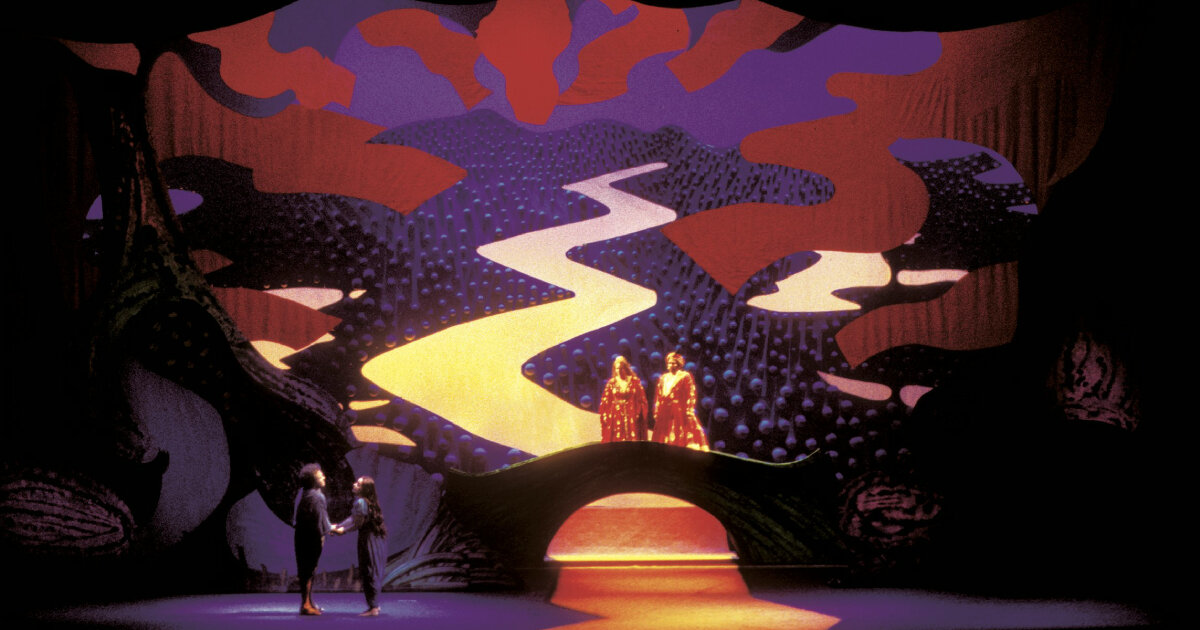
"These are not collaborations where he provided a sketch and left it for the in-house production team to realize. They are complete visual environments: painted backdrops, dimensional scenery, and costume schemes. All of them are built from the same spirit of colors and perspectives that run through his paintings and that he sees, but the difference is that the canvas is a stage, the scale is architectural, and the audience sits inside the work."
"In 2027, viewers are afforded to revisit his fantastical opera stage designs, as Tate Modern has announced that in the summer next year, the Turbine Hall is set to host a multimedia installation built around this body of work. The Turbine Hall has a roof with 524 glass panes, and the productions David Hockney designed for the stage will be projected onto vast screens inside it, enveloping the visitors into his operatic world."
"The immersive opera stage designs of artist David Hockney start with color used as structures. For Tristan und Isolde, the Wagner production he first designed in 1987, blue carries the production from beginning to end. Tristan wears blue. The sky and the cliff that defines the stage's forced perspective are blue."
David Hockney has created comprehensive opera stage designs for major opera houses across the United States and Europe since the 1970s. Unlike typical design collaborations, Hockney provides complete visual environments including painted backdrops, dimensional scenery, and costume schemes. His operatic designs employ the same vibrant colors and forced perspective techniques found in his paintings, but executed at architectural scale where audiences sit within the artwork itself. In 2027, Tate Modern will present a multimedia installation in the Turbine Hall projecting his opera designs onto vast screens, coinciding with his 90th birthday and a career-spanning retrospective at Tate Britain featuring over 200 works. His approach uses color as structural elements, exemplified in productions like Tristan und Isolde where blue defines the entire visual composition.
#opera-stage-design #david-hockney #immersive-art-installations #color-and-perspective #tate-modern-exhibition
Read at designboom | architecture & design magazine
Unable to calculate read time
Collection
[
|
...
]