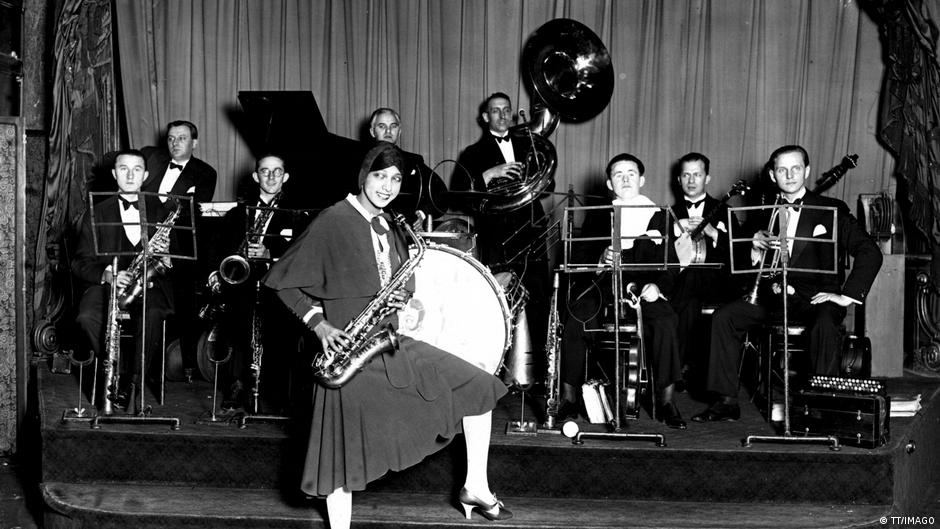
The Weimar Republic era became known for major cultural and creative breakthroughs in Germany, including Bauhaus architecture, experimental cinema, and avant-garde art and theater. In large cities such as Berlin, nightlife venues helped popularize a new music genre: jazz. Jazz entered Germany after World War I through artists connected to the United States, London, and Paris. Josephine Baker, who rose to fame in 1920s Paris, became a major German star after her 1926 Berlin debut as the “Black Venus.” By the 1930s, recordings by Louis Armstrong and Duke Ellington circulated widely. After the Nazis took power in 1933, jazz and other modern art forms faced intense pressure. Gleichschaltung brought politics, law, and culture under totalitarian control through state supervision by the Reich Culture Chamber, restricting work to Nazi-affiliated artists. Touring exhibitions attacked “degenerate” art and music and attempted to associate jazz with Jews.
"The interwar Weimar Republic period is often referred to as a "Golden Age" of culture and creativity in Germany. It was a time when groundbreaking movements, from Bauhaus architecture and experimental cinema to avant-garde art and theater, flourished against the backdrop of economic catastrophe and extreme political polarization. In big cities like Berlin, teeming with speakeasies, cabarets and hedonistic nightlife, a radically new genre of music became immensely popular."
"Jazz, which emerged from African American communities in the Deep South, was first brought to Germany by pioneering artists from the US, London and Paris after World War I. Josephine Baker, the American-born dancer, actress and jazz artist who found fame in 1920s Paris, became a huge star in Germany after her sensational debut as the "Black Venus" in Berlin in 1926. By the 1930s, records by jazz icons like Louis Armstrong and Duke Ellington were being played all over the country."
"After the Nazis seized power in 1933, modern art forms like jazz came under extreme pressure. The white supremacist Nazis, who believed that Germanic peoples belonged to a superior "Aryan master race", sought to align German society through a process known as Gleichschaltung (synchronization). This was the process of Nazification through which all aspects of society from politics and law, into art, music and everyday life, were submerged into a totalitarian system of control."
"The Reich Culture Chamber (Reichskulturkammer) placed music, arts, literature, theater, radio, film and the press under state supervision, allowing only artists belonging to Nazi-affiliated bodies to work. The Nazis produced touring exhibitions denouncing so-called 'degenerate' art and music, pictured here in Dusseldorf in 1938, and sought to link jazz with Jew"
Read at www.dw.com
Unable to calculate read time
Collection
[
|
...
]