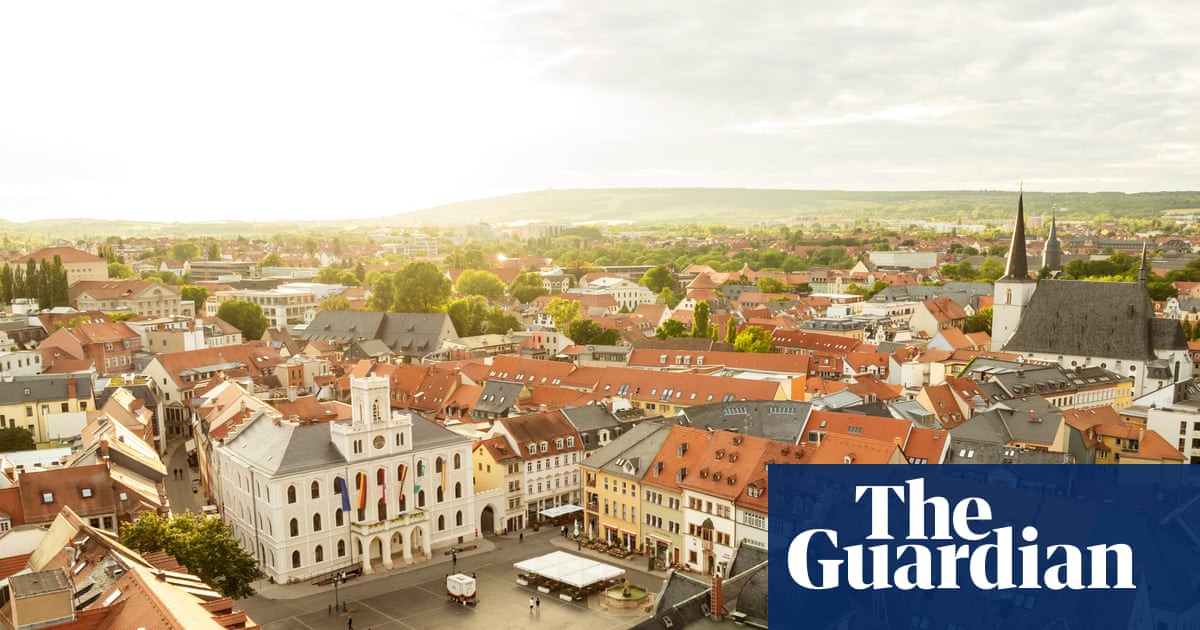
"Weimar is Germany in a nutshell, 1990s president Roman Herzog once quipped: a town in which not only culture and thought were at home but also philistinism and barbarism. The small city (population 65,000) sits at the heart of the nation and acts as a shrine to its sons Goethe, Schiller and Nietzsche. In 1919 the country's first democratic constitution was promulgated in its national theatre. It was chosen as the site of Germany's rebirth precisely because its aura of refined culture contrasted so sharply with the Prussian militarism of Berlin."
"From 1919-1925 it hosted the Bauhaus School, led by Walter Gropius, placing it at the forefront of art and design. Yet, starting in the mid-1920s, Weimar, which is also the state capital of Thuringia, became pivotal in the rise of the Nazi party and its first, regional, experiments in government. After 1933 it competed with Bayreuth for recognition as the spiritual home of Nazism."
"She divides the book into chapters chronicling local events every year between 1919 and 1939, blending public records with personal letters, diaries and memoirs left by the city's inhabitants. In this chronology, 1926 is the hinge. This was the year Weimar hosted a Nazi congress on the weekend of 3-4 July, the first rally since the party's re-foundation in 1925, following 14 months of prohibition. It was a modest affair: police estimated there were 7,000-8,000 attendees."
"Yet, the gathering established core elements of Nazism, including the Hitler Youth. On the Sunday morning, in the auditorium where the Weimar constitution had been agreed seven years before, Hitler instigated the Blood Flag ritual. Newly formed SA Stormtrooper units marched across the stage, consecrating their standards by touching them to a party flag carried during the 1923 Munich putsch, and allegedly stained with a fallen SA man's blood"
Weimar, a small German city of about 65,000 people, symbolized refined culture and national identity through figures such as Goethe, Schiller, and Nietzsche. In 1919 it hosted the promulgation of Germany’s first democratic constitution in the national theatre, and it later became associated with modern art and design through the Bauhaus School from 1919 to 1925 under Walter Gropius. In the mid-1920s, Weimar’s political role shifted as it became important to the rise of the Nazi party and its early regional governance. After 1933 it sought recognition as a spiritual center of Nazism. A key turning point occurred in 1926 when a Nazi congress in Weimar introduced foundational elements such as the Hitler Youth and included the Blood Flag ritual.
Read at www.theguardian.com
Unable to calculate read time
Collection
[
|
...
]