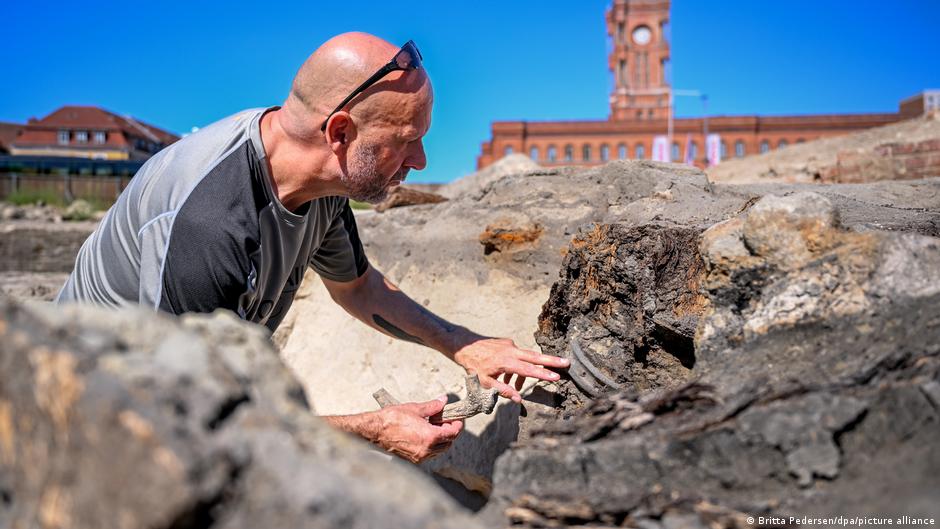
"It's often small things that reveal something about times gone by, says Eberhard Volker, archaeologist at the State Office for the Preservation of Historical Monuments. He and his colleagues suspect that goat brain was a popular snack in medieval times. Volker is leading excavations at the Molkenmarkt in the historic center of Berlin. Digging down into the past with a shovel, trowel and brush. At a depth of four meters, researchers reach the Middle Ages: the birthplace of Berlin."
"Eberhard Volker holds a thick wooden plate in his hand, a rare find. It's well-preserved but smells awful. That's no surprise when you consider it's spent centuries in a latrine, a medieval cesspit. Even after 800 years, the smell of feces still clings to it. When deprived of oxygen, organic materials such as wood, textiles and leather resist decay. That's why archaeologists often find their greatest treasures in old toilets or dried-up wells, which also served as trash cans for medieval towns."
Excavations at the Molkenmarkt expose layers of Berlin buried four meters beneath the modern surface, representing 800 years of fire debris and rubble. The site covers more than 22,000 square meters and has been worked since 2019, producing roughly 750,000 individual items. Finds include sawn-open goat skulls that suggest goat brain was eaten in medieval times, preserved organic objects from latrines and wells, a foul-smelling wooden plate, and a clay Saint Catherine figurine likely from a domestic altar. Archaeologists use shovels, trowels and brushes to recover artifacts that illuminate urban development and daily life.
Read at www.dw.com
Unable to calculate read time
Collection
[
|
...
]