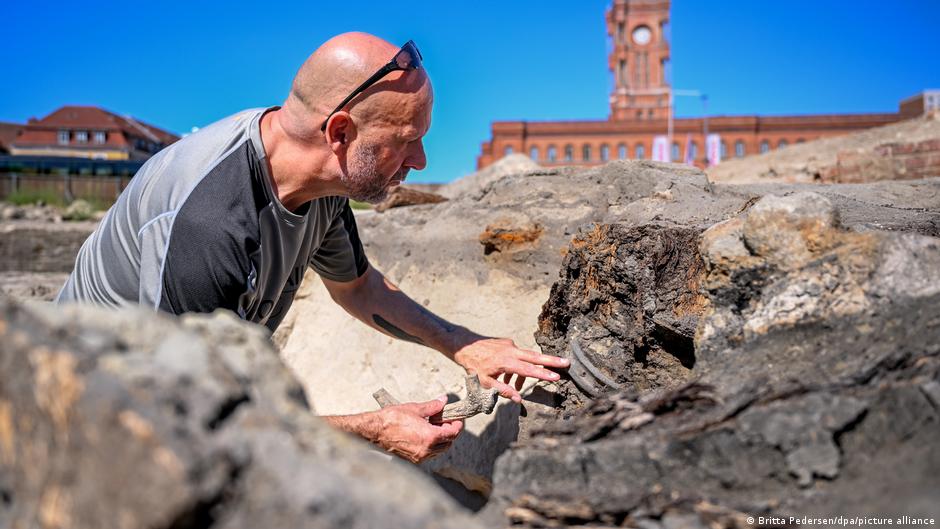
"What's the story behind the sawed-open goat skulls that frequently turn up in the ground beneath Berlin? It's often small things that reveal something about times gone by, said Eberhard Volker, archaeologist at the State Office for the Preservation of Historical Monuments. He and his colleagues suspect that goat brain was a popular snack in medieval times. Volker leads excavations at the Molkenmarkt in the historic center of Berlin, digging down into the past with a shovel, trowel and brush."
"The Molkenmarkt is one of Germany's largest inner city excavations a gigantic hole covering over 22,000 square meters (some 237,000 square feet). Once the asphalt and concrete have been removed, archaeologists can begin meticulously combing through the earth below. They've been working here since 2019, coaxing secrets out of the ground. Researchers have already turned up 750,000 individual items. The archaeological site is situated in the heart of Berlin"
Archaeologists excavating Molkenmarkt in central Berlin reach medieval deposits about 4 meters below modern street level, reflecting a four-meter rise in ground level over 800 years. The 22,000-square-meter site has produced roughly 750,000 individual objects since work began in 2019. Finds include sawed-open goat skulls suggesting goat brain consumption, a well-preserved wooden plate recovered from a latrine that still smells of feces, and a small clay figurine of St. Catherine likely from a household altar. Oxygen-deprived contexts like cesspits and wells preserved organic materials such as wood, textiles and leather.
Read at www.dw.com
Unable to calculate read time
Collection
[
|
...
]