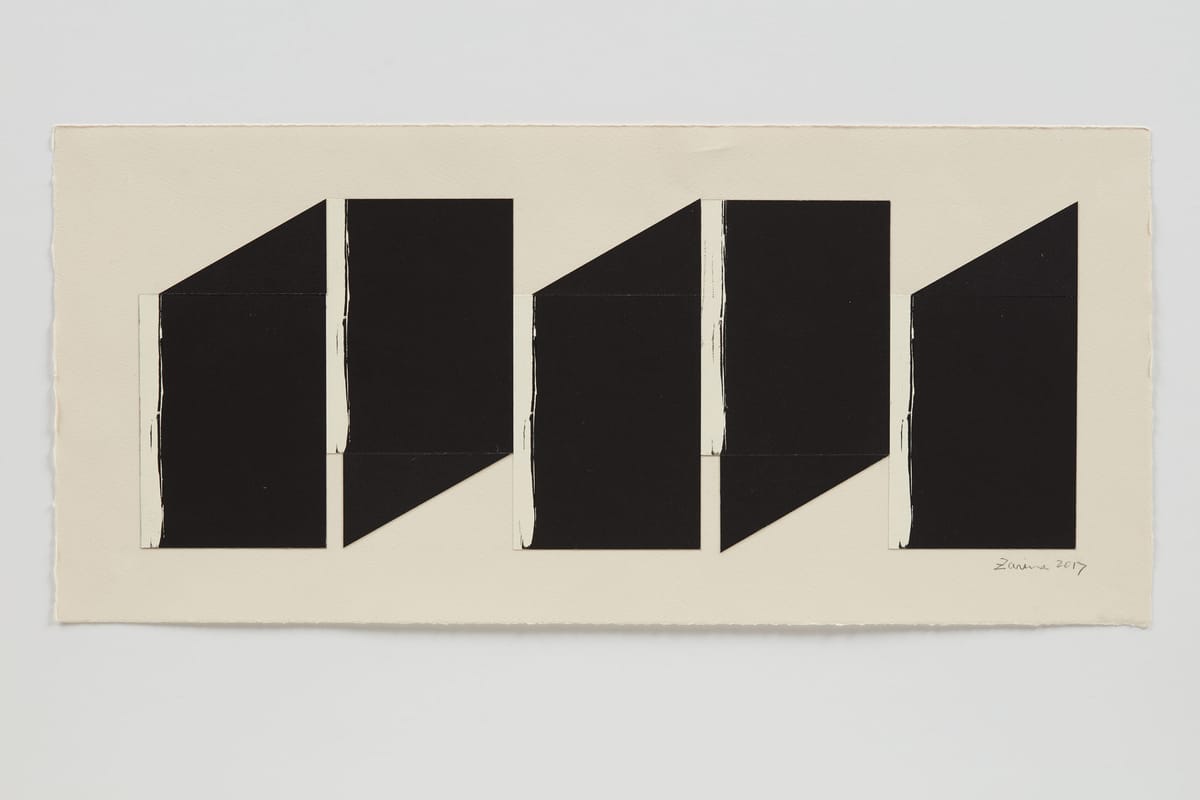
Zarina (1937-2020) was a peripatetic artist whose life spanned multiple continents following Indian Partition, when her Muslim family relocated to Pakistan. Her sparse, post-minimalist visual language—comprising prints, drawings, cast-paper reliefs, and sculptures—consistently explored mapping, home, memory, and migration shaped by both chosen and forced nomadism. Arriving in New York in 1976, she became integral to consequential art movements, including the New York Feminist Art Institute and co-editing Heresies magazine's landmark 1979 issue. She co-curated the pivotal 1980 exhibition Dialectics of Isolation featuring Third World women artists. MoMA acquired her work in 1974, and the Guggenheim presented her retrospective in 2013. Her conceptualization of home as a portable idea reflected her artistic preoccupation with dislocation while maintaining visibility as a woman of color artist.
"Zarina's work is all about dislocation - she once called "home" an "idea we carry with us wherever we go" - so it might seem perverse to emphasize her locatedness in New York. But it was precisely her presence in the city that made Zarina so important to many South Asian American artists and art workers of subsequent generations, especially women."
"Her oeuvre - spare, post-minimalist prints, drawings, cast-paper reliefs, and sculptures - consistently returns to questions of mapping place, remembering home, and understanding migration. It is indelibly marked by her nomadism - sometimes chosen, sometimes forced."
"She was a member of the New York Feminist Art Institute; on the editorial board of Heresies magazine, where she co-edited the landmark issue in 1979; and she co-curated the crucial exhibition Dialectics of Isolation: An Exhibition of Third World Women Artists in the United States with Kazuko Miyamoto and Ana Mendieta at A.I.R. Gallery in 1980."
#south-asian-american-art #migration-and-displacement #feminist-art-practice #post-minimalism #third-world-women-artists
Read at Hyperallergic
Unable to calculate read time
Collection
[
|
...
]