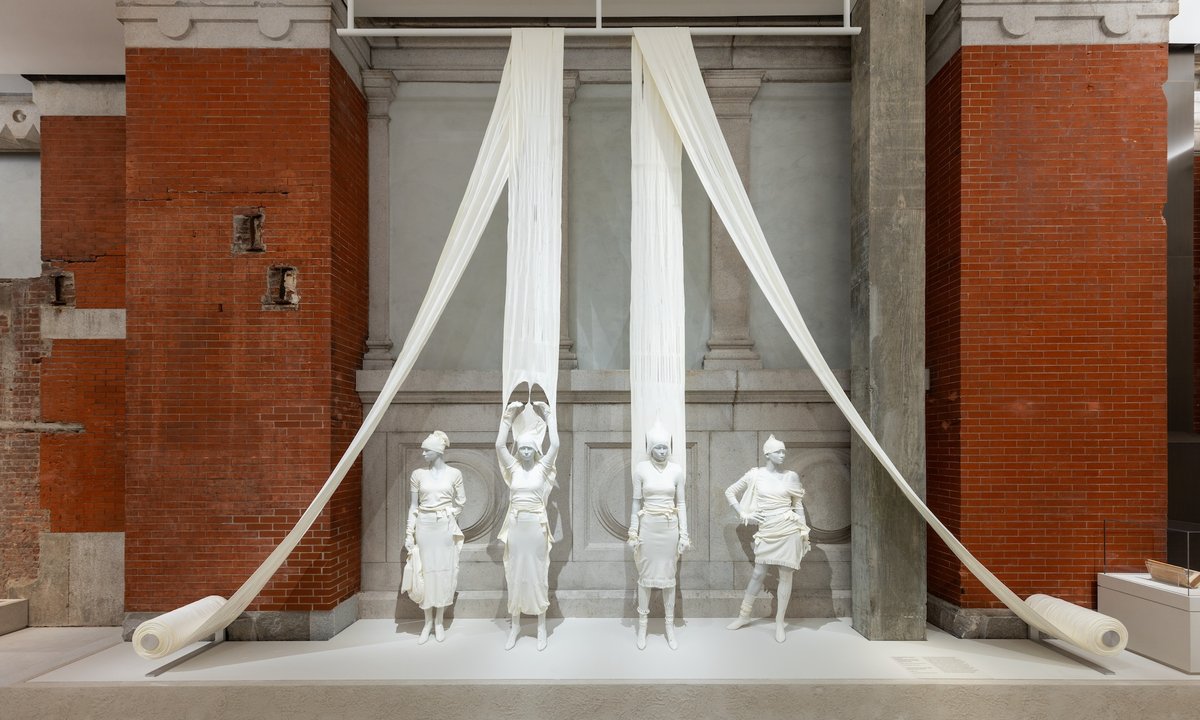
"“Across the museum's collection spanning more than 5,000 years and cultures from around the world, one constant remains: the human figure, and more precisely, the dressed body,” Andrew Bolton, the Costume Institute's curator in charge, said at the exhibition preview on 4 May."
"Together with Stephanie Kramer, the institute's senior research associate, and the research associates Ayaka Iida and Emily Mushaben, Bolton conceived Costume Art as a cross-departmental blockbuster, with nearly 400 objects drawn from all 19 of the museum's collecting areas. The show inaugurates the new Condé M. Nast Galleries, designed by the Brooklyn-based architecture firm Peterson Rich Office (PRO). Adjacent to the Great Hall, the nearly 12,000-sq.-ft space makes a powerful physical and symbolic statement about the centrality of dress within the museum."
"The exhibition's concise title has generated some confusion. It is neither a show about costumes for the stage and screen, nor a straightforward show about fashion inspired by fine art. It is, in essence, a show about and organised into various body typologies-the “Classical Body”, the “Aging Body”, the “"
A first encounter with Ancient Egyptian jewelry at a major museum created a lasting sense of wonder about how historical clothing carries psychological power. A new Costume Institute exhibition aims to harness a universal constant found across a collection spanning more than 5,000 years: the human figure, especially the dressed body. The exhibition brings together nearly 400 objects from all 19 collecting areas and opens in newly designed galleries near the Great Hall. The space emphasizes dress as central to the museum’s meaning. The exhibition title can be confusing because it is not about stage or screen costumes or simple fashion-fine-art inspiration. Instead, it is organized into body typologies such as the Classical Body and the Aging Body.
Read at The Art Newspaper - International art news and events
Unable to calculate read time
Collection
[
|
...
]