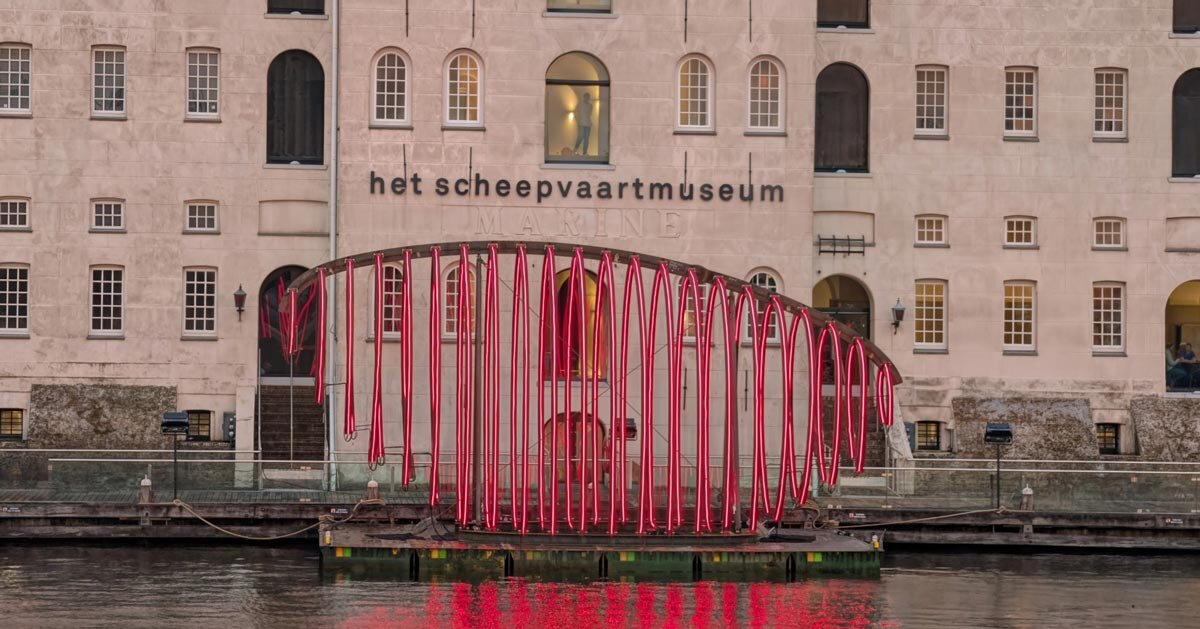
"Installed in front of Amsterdam's Het Scheepvaartmuseum, with NEMO Science Museum in the background, Whale Fall is a light installation by XYTOPIA translating the deep-sea ecological phenomenon of a whale fall into a spatial structure accessible to the . The project was selected through a two-stage international open competition with more than 700 entries, organised by the Amsterdam Light Festival under the theme 'Legacy.' Developed over eighteen months between Sydney, Beijing, and Amsterdam, the installation examines how legacy is defined and by whom."
"The work references the biological process in which a whale's body becomes a sustaining ecosystem on the ocean floor. This transformation serves as a conceptual framework for examining continuity, decay, and regeneration. Rather than presenting legacy as monument or static remembrance, the installation interprets it as a process of material and ecological transition. By drawing parallels between oceanic micro-ecologies and broader planetary systems, the project situates human impact within extended temporal scales."
"The installation's lighting sequence reinforces this reading: during the day, the structure appears as a skeletal steel framework; at night, it emits a uniform crimson glow. The shift in color and illumination marks a transition from structural exposure to atmospheric immersion, aligning the visual experience with the conceptual theme of transformation. image by XYTOPIA curved steel portal frames create Whale Fall's rhythmic space Whale Fall is composed of a sequence of curved steel portal frames forming an accessible corridor."
Installed in front of Amsterdam's Het Scheepvaartmuseum with NEMO Science Museum nearby, Whale Fall is a light installation by XYTOPIA that translates the deep-sea whale-fall phenomenon into a spatial structure. The project was selected through a two-stage international open competition with over 700 entries and was developed over eighteen months between Sydney, Beijing, and Amsterdam. The work references the biological process in which a whale's body becomes a sustaining ecosystem on the ocean floor and uses that transformation to examine continuity, decay, regeneration, and human impact across extended temporal scales. During the day the structure reads as a skeletal steel framework; at night it emits a uniform crimson glow. The installation is composed of curved steel portal frames forming an accessible, ramped corridor that encourages close interaction.
Read at designboom | architecture & design magazine
Unable to calculate read time
Collection
[
|
...
]