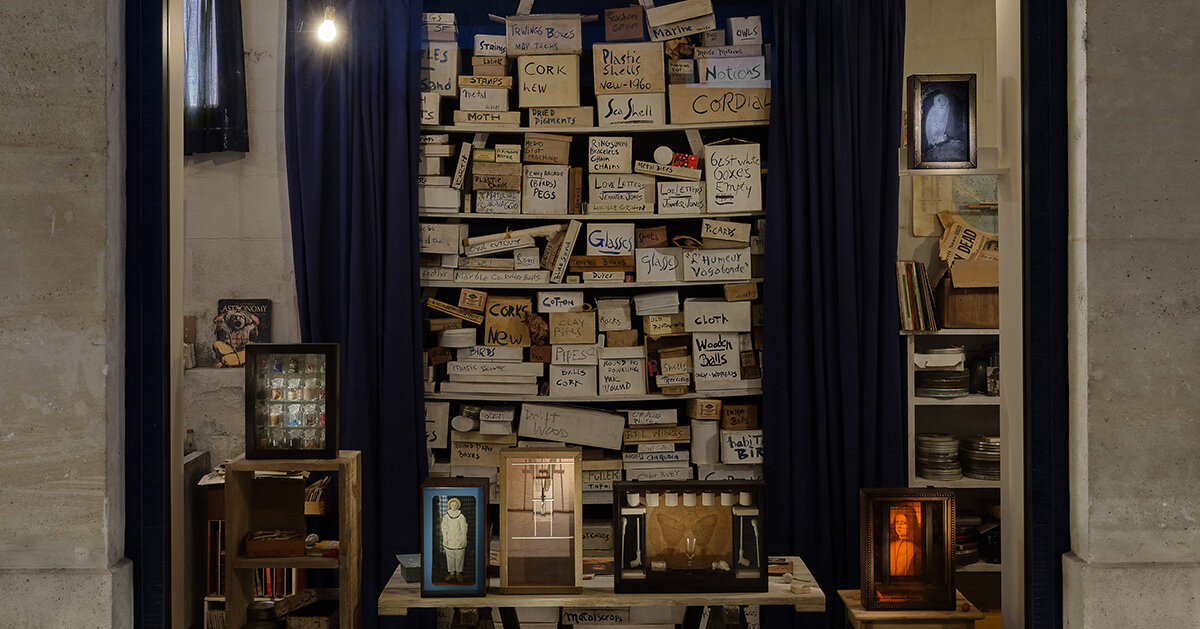
"The House on Utopia Parkway: Joseph Cornell's Studio Re-Created by Wes Anderson transforms Gagosian Paris into a reconstruction of the artist's Queens basement workspace. Conceived by curator Jasper Sharp in collaboration with the American filmmaker, the exhibition, which runs until March 14th, 2026, marks Cornell's first solo presentation in Paris in more than forty years, translating his private world of boxes, fragments, and found materials into a life-size environment that sits somewhere between installation, archive, and cinematic set."
"Rather than presenting Cornell's work through a conventional gallery display, the exhibition begins with the space itself. Anderson, working with several longtime collaborators and exhibition designer Cécile Degos, reimagines the modest studio Cornell maintained in his family home on Utopia Parkway, Queens. Shelves of whitewashed boxes, tins, and drawers are filled with more than three hundred objects drawn from the artist's own collection, including prints, feathers, marbles, maps, toys, shells, and paper scraps, what Cornell once called his 'spare parts department.'"
"Joseph Cornell (1903-1972) is often described through negation, as he did not draw, paint, or sculpt and had no formal art education. Yet working almost entirely from this basement studio, and never traveling beyond the United States, he produced one of the most influential bodies of work of the twentieth century. Paris, in particular, occupied a central place in his imagination, accessed through postcards, guidebooks, and conversations with Marcel Duchamp."
Wes Anderson and curator Jasper Sharp recreated Joseph Cornell's Queens basement studio inside Gagosian Paris, translating the artist's private workspace into a life-size environment. The reconstruction assembles shelves of whitewashed boxes, tins, and drawers filled with more than three hundred objects from Cornell's collection, including prints, feathers, marbles, maps, toys, shells, and paper scraps. The installation occupies a space between archive, cinematic set, and installation, preserving the studio's collecting and sorting practices. Cornell produced influential work largely from that modest studio without formal training and without leaving the United States, while Paris figured centrally in his imagined geography through postcards and Duchamp.
Read at designboom | architecture & design magazine
Unable to calculate read time
Collection
[
|
...
]