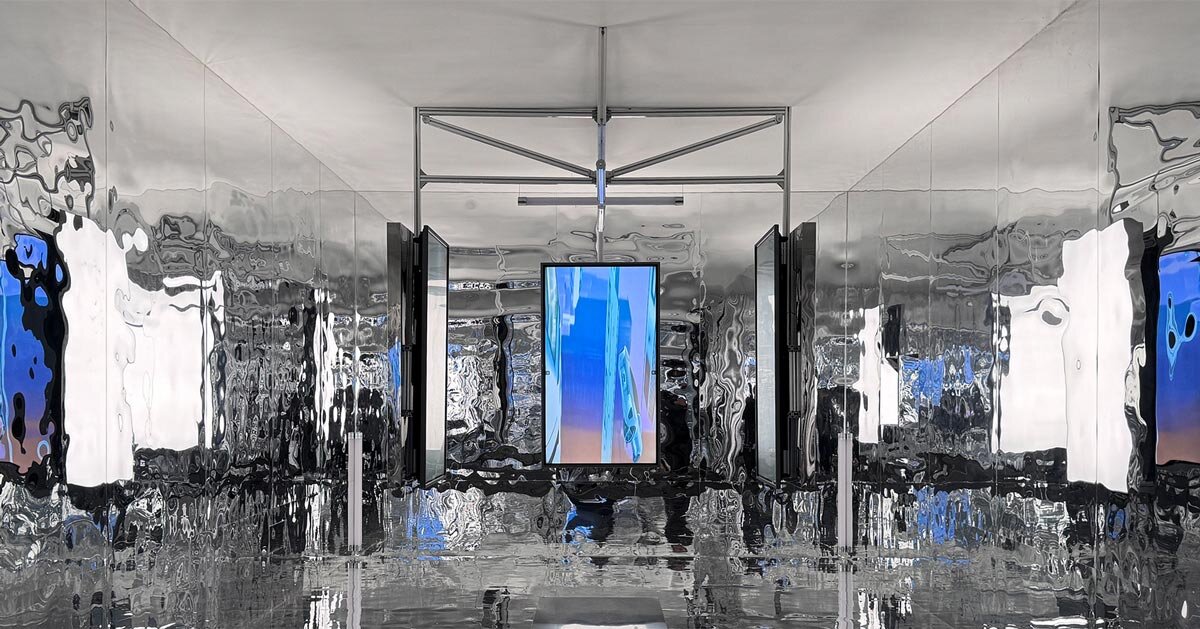
"Three digital screens are suspended within a extrusion frame, forming a sequence of vertical illuminated objects. Each screen is paired with a rear-mounted lightbox emitting bright white light. Monochromatic blue light tubes are aligned with the structural frame, positioned along the upper beam and at the corners of the space. Image, structure, illumination, and operate as a coordinated spatial system, extending the digital content into the surrounding environment."
"The exhibition is organized along a straight circulation axis defined by a brushed stainless steel pathway. This linear route establishes orientation and directs movement toward the suspended screens. Its precise geometry contrasts with the enclosure, where walls and floors are clad entirely in reflective acrylic panels. These surfaces produce ripple-like distortions, preventing stable reflections and maintaining a condition in which imagery remains visible but unresolved."
"Embedded millimeter-wave radar sensors in the ceiling register visitor presence and movement. As viewers advance, ambient lighting shifts from bright white to low-intensity monochromatic blue, aligning the spatial atmosphere with the tonal register of the AI-generated imagery. The environment responds in measurable ways to occupation, positioning perception as an active component within the"
Deferred Futures presents a spatial interpretation of Biin Shen's Between 0&1 at the Chengdu Biennale 2026, exploring artificial intelligence as a system of continuous feedback between human input and algorithmic prediction. Three suspended digital screens paired with rear-mounted lightboxes form vertical illuminated objects within an extrusion frame. Monochromatic blue light tubes align the structural frame. A brushed stainless steel pathway establishes a linear circulation axis, while reflective acrylic panels clad the walls and floors, creating ripple-like distortions that keep imagery visible but unresolved. Millimeter-wave radar sensors embedded in the ceiling detect visitor presence and movement, causing ambient lighting to shift from bright white to low-intensity monochromatic blue as viewers advance, positioning perception as an active component within the environment.
#spatial-architecture #artificial-intelligence #interactive-installation #digital-screens #responsive-environment
Read at designboom | architecture & design magazine
Unable to calculate read time
Collection
[
|
...
]