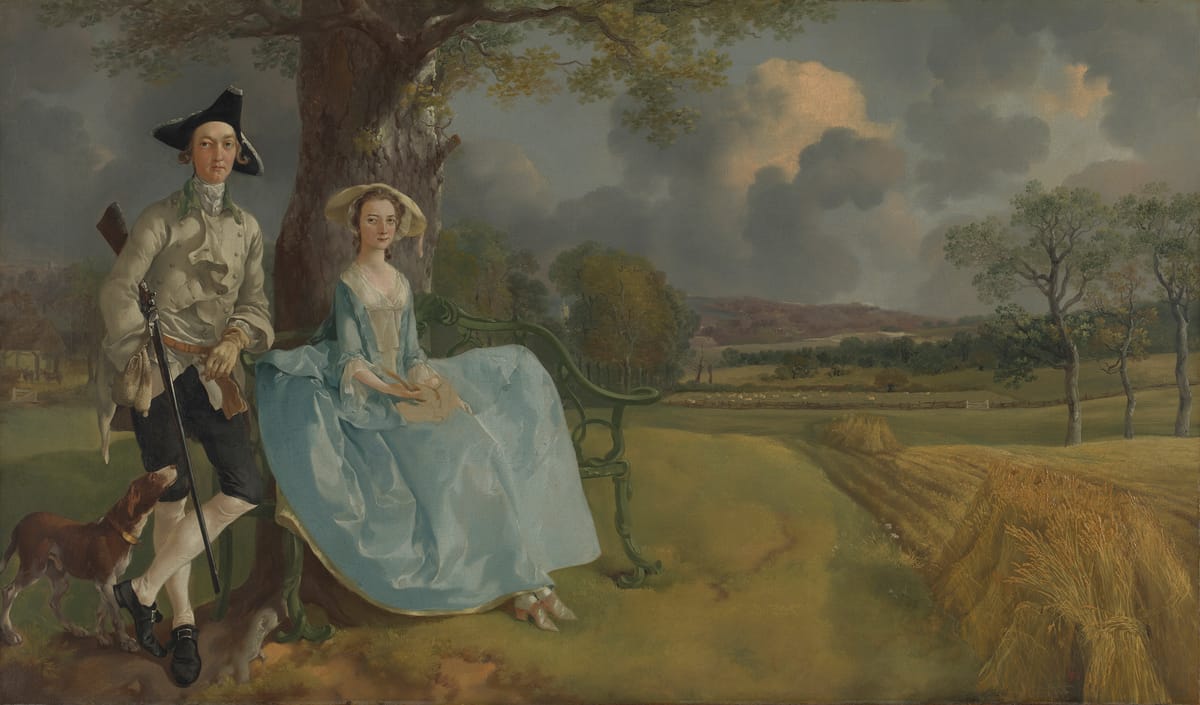
Thomas Gainsborough's portraits, particularly from his Suffolk period, demonstrate mastery in depicting landscape and clothing as markers of ownership and social status. His work evolved significantly after moving to Bath in 1759, where he refined his style through dialogue with Flemish painter Anthony van Dyck. While these paintings have been criticized for representing wealthy beneficiaries of colonization and slavery, the exhibition argues for recognizing fashion as a complex site of social negotiation. In 18th-century Britain, taste functioned as a moral technology, with philosophers like the Third Earl of Shaftesbury linking beauty to goodness, thereby legitimizing aesthetic choices as moral statements.
""Mr. and Mrs. Andrews" (1750) demonstrates what Gainsborough could already do that his contemporaries could not: make landscape and clothing equally legible as declarations of ownership and belonging, devoting as much attention to the bountiful farmland as Frances Andrews's delicate dress folds and pink satin mules."
"These paintings have long read as tired images of the wealthy who benefited from colonization and the labor of enslaved people. The exhibition acknowledges this, while insisting that more is enmeshed in Gainsborough's world, making a serious case for the complexity of fashion as a site of social negotiation."
"In 18th-century Britain, taste was a moral technology. The philosopher Anthony Ashley Cooper, Third Earl of Shaftesbury, for instance, argued that beauty and goodness were intertwined, that to cultivate aesthetic [sensibility served moral purposes]."
#18th-century-portraiture #fashion-and-social-hierarchy #gainsborough #colonial-wealth-representation #aesthetic-morality
Read at Hyperallergic
Unable to calculate read time
Collection
[
|
...
]