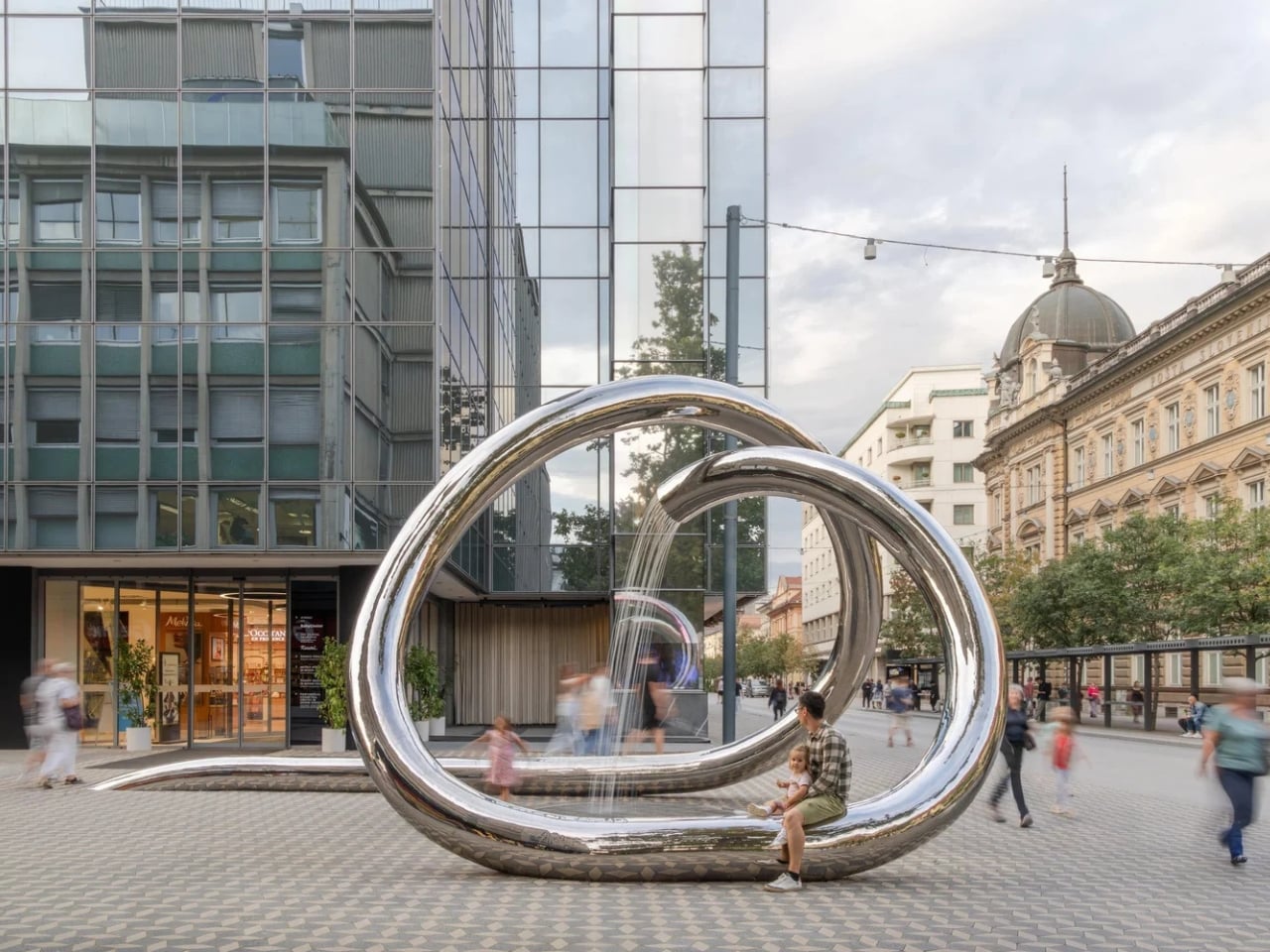
"The project was realized nine years after winning a public design competition, which gives you some perspective on how long it takes to turn a brilliant idea into something real and tangible in the middle of a bustling city. Architects Mojca Kocbek and Primož Boršič from M.KOCBEK architects and P PLUS arhitekti respectively won that competition back in 2016, and now, finally, their vision is something you can walk around, touch, and experience."
"The sculpture itself is basically a continuous loop made from stainless steel. Think of it like a ribbon that's been carefully twisted and bent into this organic, flowing shape. It creates a small urban "platform" whose continuous, rounded form establishes a separate, almost intimate space amid the city's bustle. In a dense urban environment where everything feels fast and crowded, this piece carves out a little breathing room. A place where you can sit, walk through, or just pause for a minute."
"What makes it really special is how it interacts with its surroundings. The architects chose stainless steel deliberately because of how it behaves in different conditions. The continuous, rounded form establishes a separate, almost intimate space amid the city's bustle, but it's also constantly changing based on what's happening around it. When it's sunny, the sculpture becomes almost mirror-like, reflecting the buildings and people passing by."
Water Sculpture LJ opened in central Ljubljana nine years after winning a public design competition in 2016. Architects Mojca Kocbek and Primož Boršič of M.KOCBEK architects and P PLUS arhitekti realized the project. The piece is a continuous stainless-steel loop, twisted into an organic, flowing ribbon that forms a small urban "platform" and creates an intimate space amid the city's bustle. The sculpture is interactive and invites sitting, walking through, or pausing. Stainless steel was chosen for its reflective and changing qualities: sunny conditions make the work mirror-like, while cloudy light produces a subtler, meditative presence.
Read at Yanko Design - Modern Industrial Design News
Unable to calculate read time
Collection
[
|
...
]