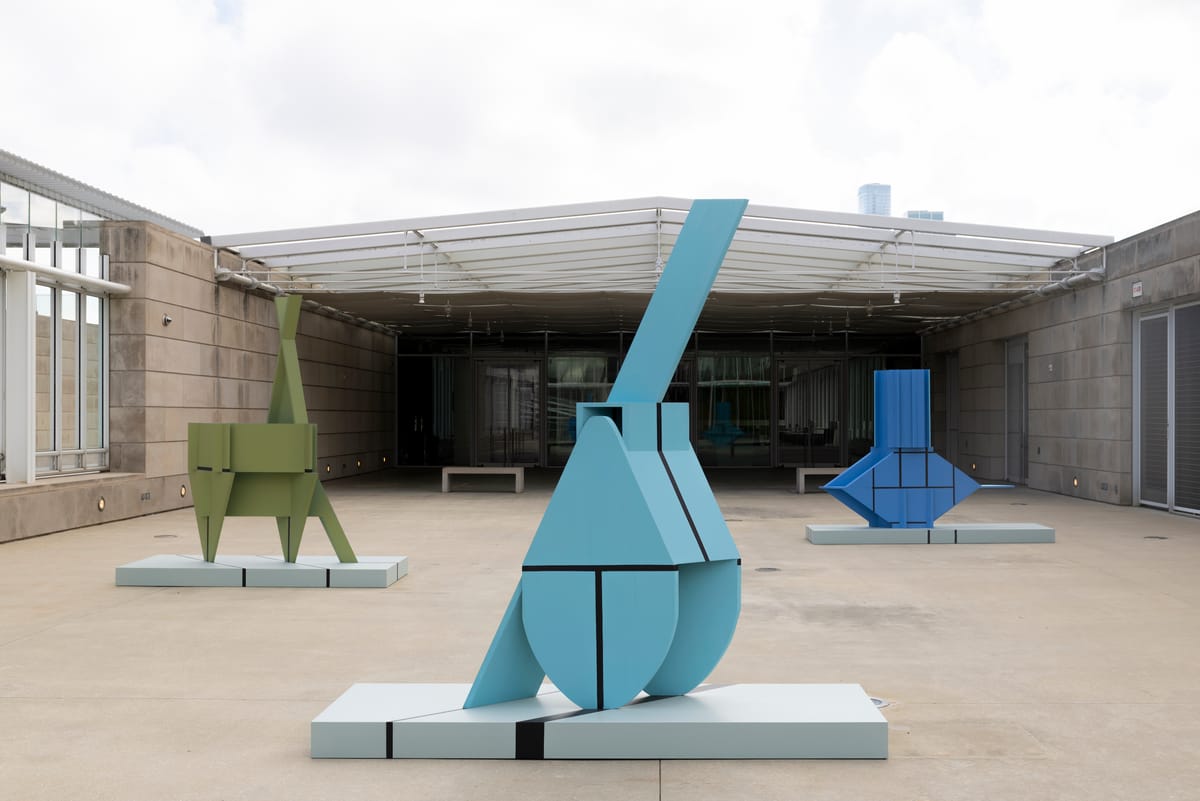
"Sculpture in the round traditionally proceeds in logically continuous increments. As you circle a baroque Bernini or modern Rodin or postmodern Charles Ray, you and the sculpture are on the same three-dimensional plane of existence. Not so with a Simpson. From one angle it appears deep, but from another flat; here it looks angled, there not. The different sides of her constructions simply do not agree with one another."
"The technical reason for this confusion is that Simpson first finds inspiration in a three-dimensional object - samurai armor, chairs, and bonnets have all been prompts - and then drafts some aspect of her source using isometric projection, a drawing style common in engineering diagrams and geometry classes, as well as historical Chinese and Japanese scrolls. It employs parallel projection and consistent angles, such that objects at a distance do not appear smaller than close ones, as in single-point perspective."
Simpson presents three outdoor sculptures on a rooftop terrace at the Art Institute of Chicago and additional works at Corbett vs. Dempsey. The works begin with inspiration from three-dimensional sources such as samurai armor, chairs, and bonnets, which are rendered in isometric projection. Isometric projection uses parallel lines and consistent angles so distant elements do not recede in scale. Simpson then translates those drawn proportions into three-dimensional constructions while preserving the projection geometry, producing sculptures whose sides contradict one another and create the sensation of walking around inside a drawing. Materials include acrylic-painted MDF.
Read at Hyperallergic
Unable to calculate read time
Collection
[
|
...
]