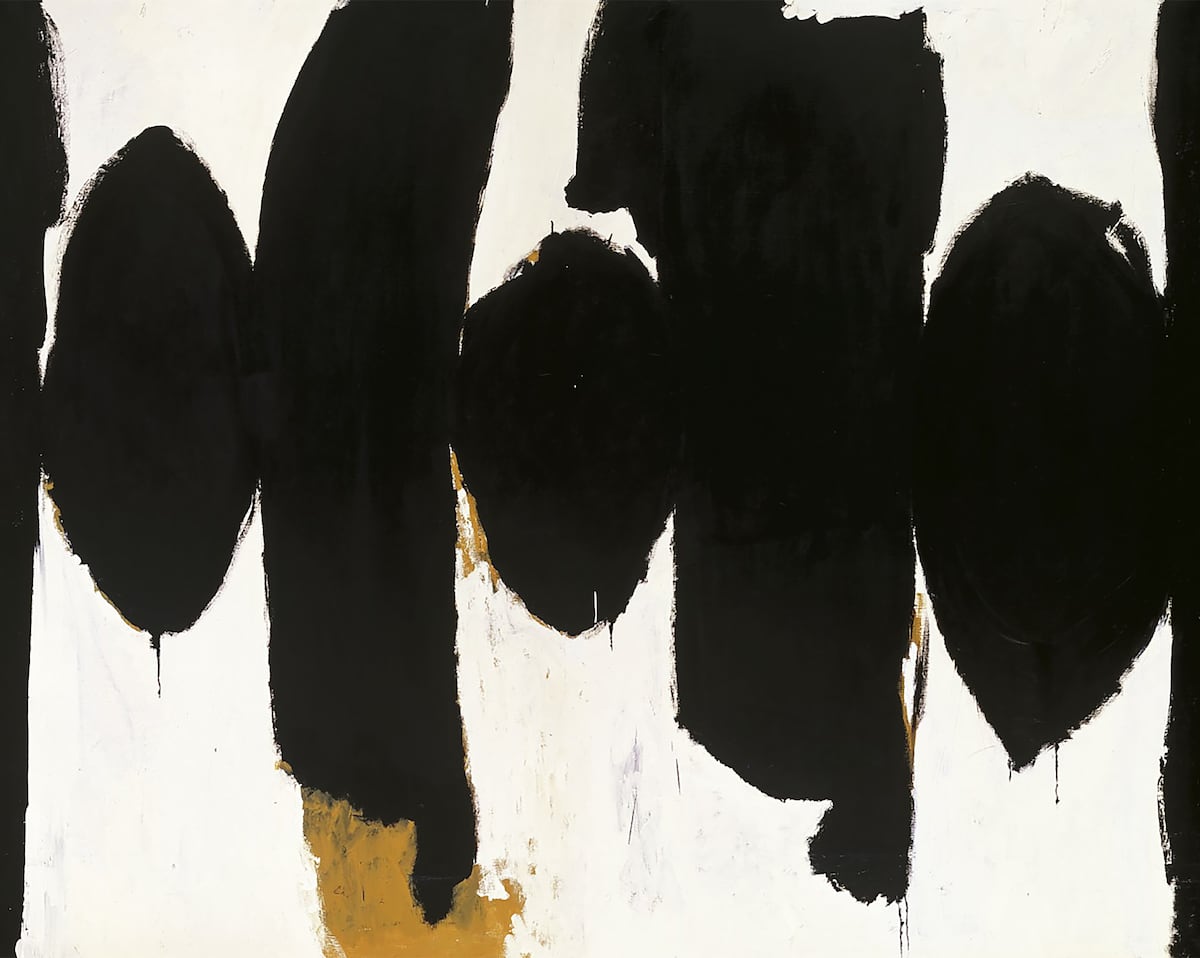
MoMA's newly released digital archives reveal detailed evidence of Francoist censorship and efforts to reinterpret abstract art to align with regime ideology. Helen Frankenthaler and Robert Motherwell traveled to Spain in 1958 while Motherwell participated in The New American Painting exhibition. Spanish authorities demanded altering the title of Motherwell's Elegy to the Spanish Republic No. 35 to a neutral name; Motherwell refused and threatened a scene. Historians long disagreed about the incident, producing rival accounts including censorship, brief newsreel appearance followed by removal, and alleged reactions from Franco. Exhibition catalogues and Motherwell's catalog raisonne have left aspects unresolved or partially inaccurate.
"Motherwell and Frankenthaler traveled to Spain in 1958. They had left New York on June 13, two months after their wedding. Their honeymoon was still pending, and she wanted her husband to see Goya's Black Paintings at the Prado Museum and the Altamira caves, taking advantage of the fact that the painter was participating with five works in The New American Painting, the MoMA traveling exhibition that presented American Abstract Expressionism for the first time in Madrid and influenced an entire generation of Spanish artists."
"But the local authorities demanded that Motherwell change the title of one of his works, Elegy to the Spanish Republic No. 35, leaving it as simply Elegy or Painting. The painter, furious, refused and even threatened to cause a scene in Madrid. For decades, historians, clouded by Francoist propaganda, have disagreed about what happened. Some said the painting was censored, without specifying how. Others maintained it appeared in a Spanish newsreel before being removed,"
Read at english.elpais.com
Unable to calculate read time
Collection
[
|
...
]