"O'Keeffe's renderings of Northern New Mexico - which do not include Tewa people or culture - and the lore of her independent settler spirit are ingrained in the history of Western Modernism, and they continue to attract tourists, artists, and collectors to the region. Her self-proclaimed divinely sanctioned possession of the land is vital to consider when thinking critically about her art."
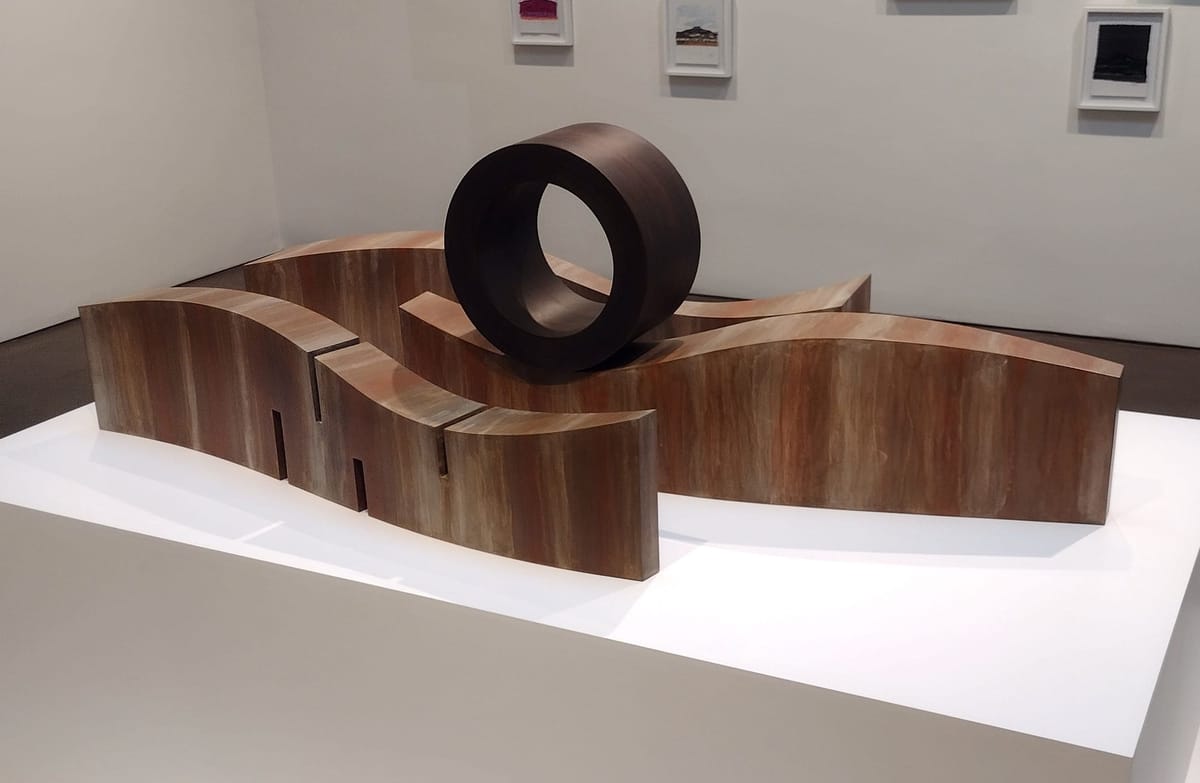
"Arlo Namingha (Ohkay Owingeh, Hopi) evoked direct experiences with nature through minimalist abstractions. His "Paa' Shad'eh" (Deer Dance) (2025), a sculpture composed of four stacked blocks of stone, references the cardinal directions, deer tracks, ceremonial practices, and nature's life-giving energy, such as lightning. "Sandhills" (2008) comprises four bronze pieces, including a cylinder representing the sun, that can be arranged relative to one's relationship to changing surroundings."
Visitors to Georgia O'Keeffe's Abiquiu house often recognize landscapes familiar from O'Keeffe's paintings. O'Keeffe's depictions of Northern New Mexico omit Tewa people and culture and contribute to a settler narrative that frames land possession as divinely sanctioned. The Tewa Nangeh/Tewa Country exhibition at the Georgia O'Keeffe Museum places works by Tewa Pueblo artists, scholars, and culture bearers alongside O'Keeffe landscapes to contest that narrative. Comparative displays create productive tensions. Arlo Namingha's minimalist sculptures reference cardinal directions, ceremonial practices, deer tracks, and natural energies, emphasizing honoring animal life and traditions.
Read at Hyperallergic
Unable to calculate read time
Collection
[
|
...
]