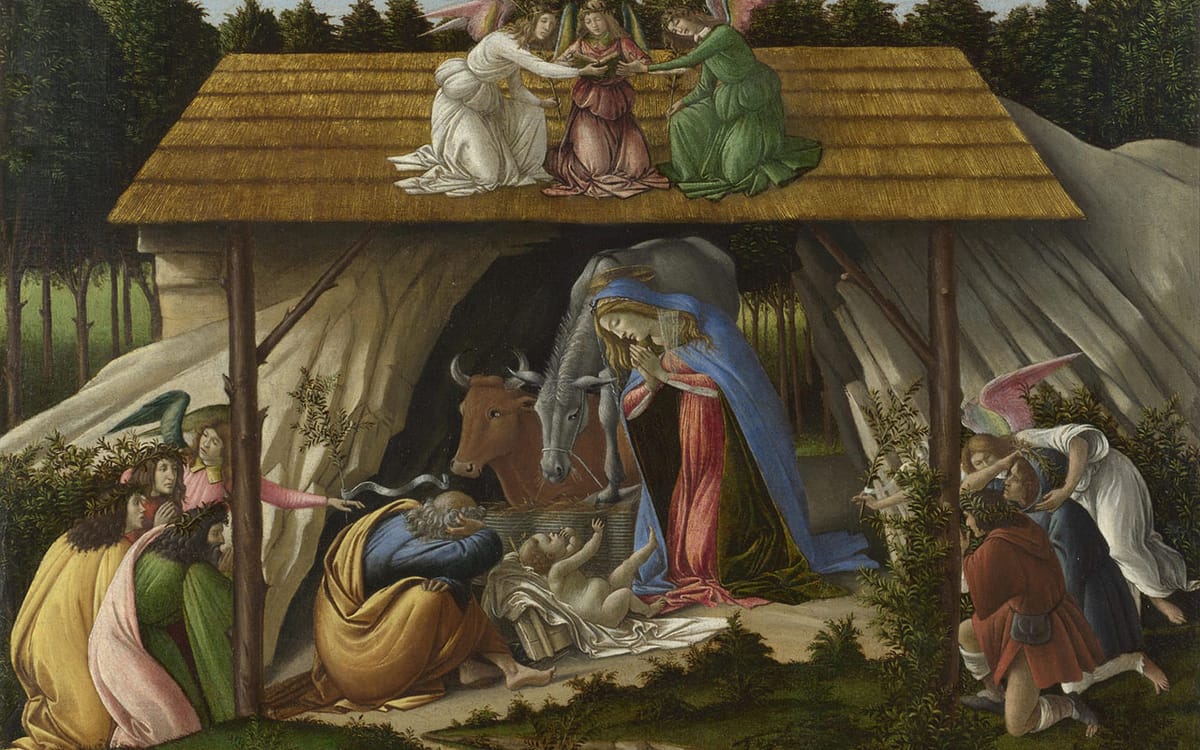
"Eschewing the wooden panels on which he normally rendered his compositions, Botticelli's latest painting was on canvas - the better to roll it up, should its incendiary message anger Florence's rulers. Indeed, just a few years before he completed the painting, Savonarola, then powerful in the city-state, had been sentenced to death in part for his thunderous edict that Florentines should let the "rich give to the poor, [and] let the churches be stripped of their excessive wealth.""
"In all its artistic iterations across millennia, the nativity - the birth of Jesus in a humble manger - remains inherently political. It reveals not just the paradox of divine embodiment, but the radical truth of equality inherent in God choosing to enter the world in marginalized circumstances, thereby declaring the sacred dignity of all human beings and our moral obligations to one another."
Botticelli completed The Mystical Nativity around 1500 on canvas so the work could be rolled up if its message angered Florence's rulers. Girolamo Savonarola had been martyred less than two years earlier after urging that the rich give to the poor and that churches be stripped of excessive wealth. An early nativity archetype appears in an Egyptian Sahara cave painted in red ochre, showing simple male and female figures with a floating infant and a star. Nativities take sentimental, censorious, sugary, or surreal forms and consistently present divine embodiment amid marginalized circumstances, asserting equality, sacred human dignity, and moral obligations.
Read at Hyperallergic
Unable to calculate read time
Collection
[
|
...
]